Faith Odhiambo cautions increment in tax burden in Finance Bill 2026
By Ndiritu Wanjiru, May 8, 2026Former Law Society of Kenya president Faith Odhiambo has echoed concerns from the many provisions of the Finance Bill, 2026, that could see Kenyans’ tax burden become significantly higher, financial inclusion further eroded, and the compliance burden on businesses heavy.
Taking it to her Facebook account on Friday, 8th May, 2026, Faith has noted that the Finance Bill, 2026, which was gazetted on 30th April and is currently before the parliament, is seeking to raise Ksh3.63 trillion in revenue in the 2026/27 financial year, with the budget deficit projected to widen to 5.3% of GDP from 4.7% in 2025/26.
The government targets Ksh3.63 trillion in revenue for 2026/27 and a wider budget deficit of 5.3% of GDP in the 2026/27 fiscal year (July-June), up from 4.7% in 2025/26. These are not unreasonable fiscal objectives, but the manner in which the burden of achieving them is distributed is a cause for serious concern,” Odhiambo stated.
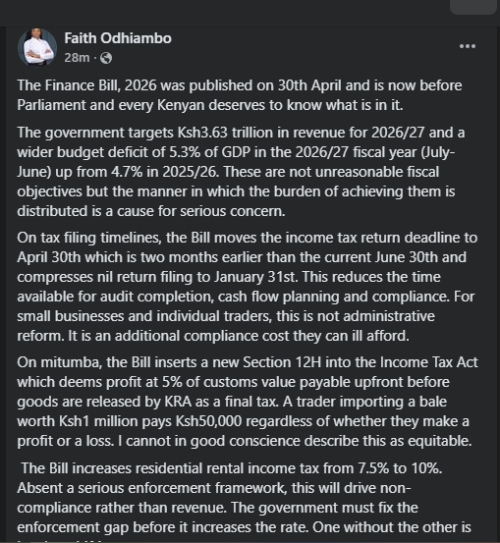
One of the changes recommended is that the tax return due date for income tax has been shifted from June 30th to April 30th, and the due date for filing nil returns has been reduced to January 31st.
“This means that there is less time to complete the audit, complete cash-flow planning, and meet compliance requirements,” she warned.
Tax increment
The Bill also brings in a new taxation model for Mitumba traders, a proposed Section 12H of the Income Tax Act, which considers the profit made by Mitumba traders at 5 per cent of the customs value, and tax is collected up front before goods are released. Odhiambo says this is unfair because traders will be charged taxes even if they make losses or gains.
The Bill aims to increase the tax rate for residential rents from 7.5 per cent to 10 per cent. If there is no substantial improvement in enforcement mechanisms, she says, the rise is likely to exacerbate the issue of non-compliance instead of boosting revenue collection, leaving the problem of non-compliance unabated and the burden on the tax taker.

Further, Odhiambo has noted that the Finance Bill also phases out the VAT exemption for digital financial services, including money transfer and payment processing. Such services are key to financial inclusion and are used every day by millions of Kenyans as essential financial tools. She warns that raising the price of these services will negatively impact people’s ability to access these tools.
Moreover, Faith has observed that the fact that the withholding tax rate applies to management and professional fees, with the inclusion of interchange and merchant service fees, is anticipated to increase the costs associated with complying with the withholding tax. She says businesses and consumers will be charged these costs, too.
She has added that one of the most contentious amendments proposed in the proposed amending regulation is the change of Section 24 of the Income Tax Act that will enable the Kenya Revenue Authority to treat as taxable dividends at least 60% of the income of a company that is not distributed to shareholders. Odhiambo says this is an overlook of the legitimate business requirement of reinvestment and retention of working capital, which may not encourage business investment.
In addition, Faith has indicated that the bill would introduce an excise duty of 25 per cent on telephones used in cellular and wireless networks. Mobile phones are vital instruments for banking, communication and accessing government services and should not be considered luxury items, she cautions.
Absence of PAYE tax relief
Odhiambo says that on the PAYE side, there was no tax relief, as well as the banding of income tax, like what was being expected by many of the salaried workers. The absence of this needs to be clearly explained by the government, she says, especially in view of the financial hardship on households.

She also calls for the waiving of VAT taxes on electric buses, bicycles, dialysis equipment, animal feed inputs and public-private partnership projects for infrastructure. Also of note, she points out enhancements to trust taxation rules to prevent double taxation and to exclude the receipt of gratuity contributions from income.