European Union demand release of bodies, political prisoners in Tanzania
By Kenneth Mwenda, December 5, 2025The European Union and a group of Western diplomatic missions have called on Tanzanian authorities to urgently release the bodies of those killed in post-election violence and free all political prisoners.
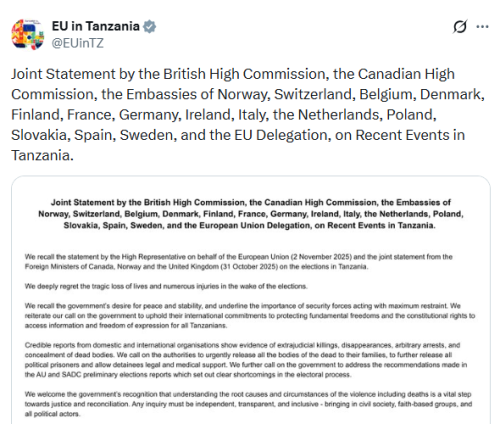
The joint statement was issued by the British High Commission, the Canadian High Commission, and the embassies of Norway, Switzerland, Belgium, Denmark, Finland, France, Germany, Ireland, Italy, the Netherlands, Poland, Slovakia, Spain, Sweden, and the European Union Delegation.
It recalls an earlier statement by the EU High Representative on November 2, 2025, and a joint statement from the Foreign Ministers of Canada, Norway, and the United Kingdom on October 31, 2025.
The statement expressed deep regret over the loss of lives and numerous injuries following the elections. It highlighted the government’s desire for peace and stability, stressing the importance of security forces acting with maximum restraint.
The missions called on the Tanzanian government to uphold international commitments to fundamental freedoms, including the constitutional rights to access information and freedom of expression.
“We deeply regret the tragic loss of lives and numerous injuries in the wake of the elections,” the statement reads.
“We recall the government’s desire for peace and stability, and underline the importance of security forces acting with maximum restraint. We reiterate our call on the government to uphold their international commitments to protecting fundamental freedoms and the constitutional rights to access information and freedom of expression for all Tanzanians.”
Reports from domestic and international organisations indicate extrajudicial killings, disappearances, arbitrary arrests, and concealment of bodies. The statement urged authorities to release all bodies to families, free political prisoners, and provide legal and medical support for detainees.
It also called for the government to implement recommendations from the African Union and Southern African Development Community preliminary election reports, which identified clear shortcomings in the electoral process.
The EU and Western missions welcomed the government’s recognition that understanding the root causes of the violence is a vital step toward justice and reconciliation. They stressed that any inquiry must be independent, transparent, and inclusive, involving civil society, faith-based groups, and all political actors.
US raises Tanzania concerns
The United States has also escalated its position. On Thursday, the U.S. State Department announced a comprehensive review of its bilateral relationship with Tanzania. Principal Deputy Spokesperson Tommy Pigott said Washington values its long partnership with the Tanzanian people but warned that recent actions by the government raise grave concerns.
He cited repression of religious freedom and free speech, barriers to U.S. investment, and violence around the October 29 elections. The statement said these actions have put American citizens, tourists and U.S. interests at risk. The State Department added that the future of the relationship will depend on the Tanzanian government’s actions going forward.
Senator James Elroy Risch, Chairman of the Senate Foreign Relations Committee, also warned that the situation threatens the stability and security of the region. He called for a thorough review of what he described as violent repression, including cases against Christian leaders.
Senator Risch also highlighted reports that US-based tech companies blocked social media accounts of Tanzanian activists, including some based in the United States. Among those affected is Mange Kimambi, a former fashion model turned activist with nearly three million Instagram followers. Kimambi criticised President Samia Suluhu Hassan and mobilised protests against the government.
The Tanzanian government accused her of inciting deadly post-election protests. Meta, the parent company of Instagram, said the account removal was due to violations of its recidivism policy, which prevents users from creating new accounts after being removed for repeated violations. Kimambi denied the accusations, saying her posts encouraged peaceful protests and gave Tanzanians a platform to voice dissent.
Another activist, Maria Sarungi, also faced restrictions. Kimambi suggested the actions may have been taken under pressure from the Tanzanian government. She appealed to US President Donald Trump to urge Meta to restore her accounts.
The crackdown follows the disputed October 29 elections, which saw President Samia win with around 98 per cent of the vote after main opponents were blocked from contesting. Opposition leaders and rights groups report hundreds of protesters were killed, though the government has not released official figures.