Education budget review exposes gaps in teacher welfare cover
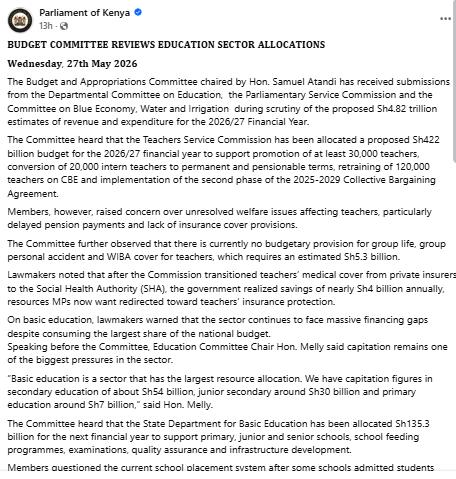
By Kenneth Mwenda, May 28, 2026The Budget and Appropriations Committee has raised concern over gaps in teacher welfare coverage, especially the absence of key insurance protections, during its review of education sector allocations for the 2026/27 financial year.
The committee, chaired by Samuel Atandi, is examining proposed estimates totalling Ksh4.82 trillion. It heard submissions from the Departmental Committee on Education, the Parliamentary Service Commission and the Committee on Blue Economy, Water and Irrigation.
The Teachers Service Commission (TSC) has been allocated a proposed Ksh422 billion. The funds will support the promotion of about 30,000 teachers, conversion of 20,000 intern teachers to permanent and pensionable terms, retraining of 120,000 teachers under the Competency-Based Education (CBE) programme, and implementation of the second phase of the 2025–2029 Collective Bargaining Agreement.
Unresolved welfare issues
However, MPs focused on unresolved welfare issues affecting teachers, with particular concern over delayed pension payments and missing insurance cover.
The committee noted that the budget has no provision for group life insurance, group personal accident cover, and Work Injury Benefits Act (WIBA) insurance for teachers. Lawmakers said these protections would cost about Ksh5.3 billion but remain unfunded.
Members warned that leaving out these covers exposes teachers to financial risk, especially in cases of injury, disability or death while on duty.
Lawmakers also pointed out that after the shift of teachers’ medical cover from private insurers to the Social Health Authority (SHA), the government saved nearly Ksh4 billion annually. They proposed that part of these savings should go towards funding insurance protection for teachers.
On basic education, the committee noted persistent funding gaps despite the sector receiving the largest share of the national budget. Capitation remains a key pressure point.
“Basic education is a sector that has the largest resource allocation. We have capitation figures in secondary education of about Ksh54 billion, junior secondary around Ksh30 billion and primary education around Ksh7 billion,” said Education Committee Chair Hon. Julius Melly.
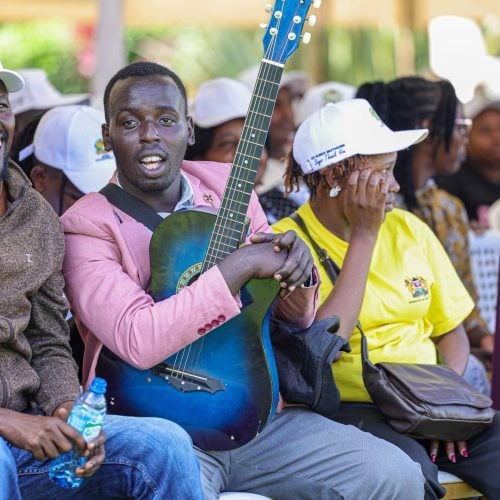
MPs push education reforms
The State Department for Basic Education has been allocated Ksh135.3 billion for schools, examinations, school feeding programmes, infrastructure and quality assurance.
MPs also questioned the current school placement system, saying some schools remain overcrowded while others operate below capacity.
The committee backed proposals to improve the school feeding programme, including fresh mapping of beneficiary areas and better inclusion of learners with special needs. It also recommended that the National Council for Nomadic Education in Kenya (NACONEK) remap targeted regions and set clear inclusion guidelines.
Lawmakers further supported direct disbursement of co-curricular funds to schools to avoid delays that disrupt sports, music and drama activities under CBE.
The State Department for Higher Education will receive Ksh164.1 billion, while MPs noted ongoing concerns around scholarship funding under the new model.
In technical education, the committee welcomed an increase in TVET capitation from Ksh3.5 billion to over Ksh9 billion.
“This time it has been raised to over Ksh9 billion for TVET students, and this is actually to ensure that they go back to colleges and we are able to fund them,” said John Chikati.
The government has announced a major boost in teacher promotions, with Deputy President Kithure Kindiki confirming that 50,000 teachers will be promoted in the coming financial year. He said the decision follows increased budgetary allocation and consultations with education stakeholders, including teachers’ unions.
“In this budget, I confirm that we have factored in money for promotions. Initially, the target was 25,000 teachers. You informed the President that the number was not enough, and the government will now be promoting 50,000 teachers,” Kindiki said.
The committee also called for an audit of equipment in TVET institutions to redistribute idle machinery and strengthen training capacity.
Members maintained that stronger education financing remains key to improving teacher welfare, expanding access, and supporting the rollout of CBE across the country.