Duale highlights ambitious plan to end preventable maternal and newborn deaths
By Ndiritu Wanjiru, June 1, 2026The government, through the Ministry of Health, has announced a new national strategy for achieving the reduction of all preventable deaths of mothers and newborns by announcing President William Ruto’s Every Woman Every Newborn Everywhere (EWENE) Acceleration Plan 2026–2028.
In a statement by Health Cabinet Secretary Aden Duale on his X handle on Sunday, May 31, 2026, the strategy aims to boost maternal and newborn health services in Kenya by allocating more money, enhancing emergency response mechanisms, and scaling up healthcare staffing.
The plan follows increased efforts by the Ministry of Health to stem maternal deaths and increase survival rates for babies, especially in remote and underserved areas of the country.
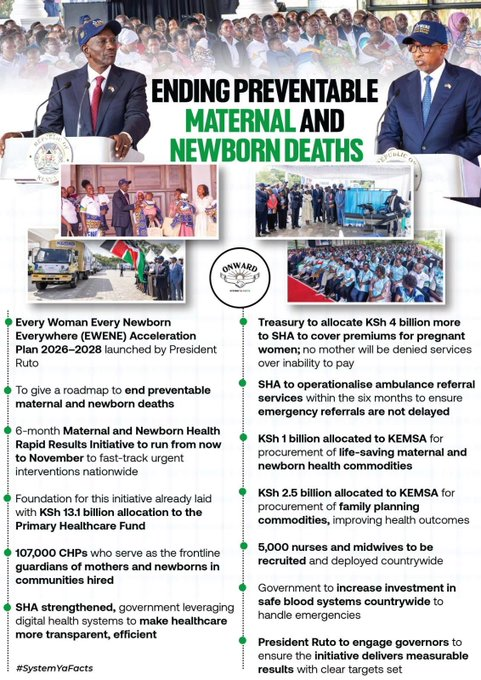
“The Every Woman Every Newborn Everywhere (EWENE) Acceleration Plan 2026–2028, launched by President Ruto, gives a roadmap to end preventable maternal and newborn deaths. The 6-month Maternal and Newborn Health Rapid Results Initiative will run from now to November to fast-track urgent interventions nationwide. The foundation for this initiative is already laid with a Ksh13.1 billion allocation to the Primary Healthcare Fund,” Duale stated in a statement.
Plan to transform maternal and newborn healthcare
The EWENE Acceleration Plan 2026–2028 offers a clear, actionable plan, designed to save preventable maternal and newborn deaths by intervening through specific actions and supporting health systems. The strategy is based on access to quality health care services for the expectant mothers and newborns in all areas on time.
To support the rollout, the government has launched an interim six-month Maternal and Newborn Health Rapid Results Initiative (RRMNH-RRI) that will be implemented until November 2026. It is hoped that the programme will expedite critical interventions across the country and ensure that maternal and newborn health services are more efficient and effective at all levels of care.
The base of the initiative has already been strengthened with the allocation of Ksh13.1 billion to the Primary Healthcare Fund (PHF) to support the delivery of quality healthcare at the community level. The government has also hired 107,000 community health promoters as frontline workers who will be helping to provide maternal and newborn health services in the community.
The SHAs are also being enhanced, with digital health systems designed to enhance transparency, efficiency and accessibility in the provision of health care services.
Allocation for maternal health services and emergency care
The National Treasury will also provide an extra Ksh4 billion to the Social Health Authority to pay for health insurance premiums for pregnant women to enable the programme to be implemented. This intervention is anticipated to leave no financial hindrances for women who are pregnant to receive necessary health care services.
The government has also stated it will make the ambulance referral service operational within six months. This will be expected to greatly decrease response time to emergencies and increase the likelihood of the survival of mothers and their newborns in emergency scenarios.
Other monies in the plan amount to Ksh1 billion to be used for KEMSA procurement of life-saving maternal and newborn commodities and Ksh2.5 billion for procurement of commodities for family planning to bolster reproductive health services.

The government will also hire and mobilise 5,000 nurses and midwives nationwide to help alleviate the shortage in health facilities. Meanwhile, there will be a rise in the investment in safe blood systems across the country to improve the preparedness for emergent situations and maternal care.
According to Duale, the programme is also expected to see President Ruto engaging with county governors via specific targets and accountability mechanisms for its successful implementation.
Reduction in maternal and newborn mortality
The Ministry of Health has said it is confident that the integrated interventions will make a substantial contribution to the strengthening of the health system, increase access to quality maternal services and enhance emergency response to pregnant women and newborns.
Health Cabinet Secretary Aden Duale has reiterated that the exercise is a testament to the government’s determination to save the lives of mothers and babies and bring about faster implementation of the strides towards universal health coverage.
Through additional funding, scaling up health systems’ capacity, building robust referral networks, and making health systems more accessible, Kenya is committed to achieving significant improvements in maternal and newborn mortality rates and quality and equitable access to health services across geography and income.