Did Gen Zs’ demos mark a turning point in Kenya’s politics? New report explains
By Aloys Michael, May 9, 2026Kenya’s 2024 anti-Finance Bill protests may ultimately be remembered as the moment the country’s political order changed forever.
What began as online anger over proposed tax increases evolved into one of the most consequential youth-led uprisings in Kenya’s democratic history, forcing President William Ruto to withdraw the Finance Bill, dissolve his Cabinet and reconfigure alliances at the heart of government.
Now, a new international governance assessment suggests the protests exposed deep fractures within Kenya’s political and economic system.
According to the BTI 2026 Country Report on Kenya by Bertelsmann Stiftung, the proposed Finance Bill 2024 sparked widespread public protests after introducing several new tax measures, including taxing previously exempt items and broadening the tax base.
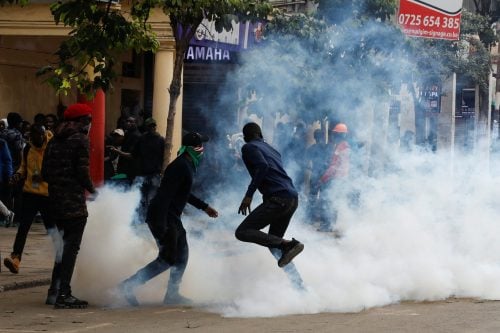
The report says the demonstrations reached a historic turning point on June 25, 2024, when protesters breached Parliament buildings in Nairobi.

“Parliament buildings were set ablaze, marking a turning point in Kenyan politics,” the report states.
The protests were largely driven by young Kenyans frustrated by rising living costs, unemployment and increasing taxation.
President Ruto’s administration had entered office promising a Bottom-Up Economic Transformation Agenda (BETA) that would empower ordinary citizens through initiatives such as the Hustler Fund.
But the report paints a starkly different reality.
“Several months into its tenure, economic indicators deteriorated. The cost of living soared, with the prices of maize flour, fuel, kerosene and other basic goods reaching record highs,” the report notes.
The government inherited a heavily indebted economy with limited fiscal space, forcing it to pursue aggressive revenue collection measures and subsidy removals.
That economic pressure collided with a digitally connected generation already struggling with joblessness and shrinking opportunities.
Unlike previous protests shaped by ethnic political blocs, the 2024 demonstrations were largely decentralised and coordinated online.
The report highlights that Kenya’s youth-led movement disrupted traditional political alignments and triggered panic within the ruling establishment.
“In response, President Ruto dissolved his cabinet and announced a series of measures to appease the protesters,” the report says.
The report observes that political parties in Kenya continue to have “weak ideological bases” and instead mobilise support through “ethnoregional interests.”
PHOTO/@channelafrica1/X
Yet the Gen Z protests appeared to transcend those divisions.
Taming legacy politics
Many demonstrators openly rejected both government and opposition leaders, accusing the entire political class of benefiting from corruption, debt accumulation and economic exclusion.
The unrest also revealed the risks facing the government as public frustration collides with a struggling economy.
The BTI report notes that Kenya’s debt burden surged from 39 per cent of GDP in 2010 to more than 73 per cent in 2023, worsened by corruption, external shocks and heavy borrowing.
The proposed taxes were intended to help close fiscal deficits and reassure international lenders.
Instead, they ignited the largest youth uprising Kenya has seen in years.
The report says the aftermath of the protests also altered the country’s political landscape.
To stabilise his administration, Ruto reached an agreement with the late opposition leader Raila Odinga, allowing several ODM politicians to join the government.
“This move has further blurred the lines between the government and the opposition,” the report says.

The broad-based arrangement weakened opposition oversight while helping Ruto consolidate power following tensions with then-Deputy President Rigathi Gachagua.
But the report warns that the government’s response to dissent could have long-term democratic consequences.
“Decision-making may be driven more by survival tactics than by a focus on service delivery,” it cautions.
Even so, the protests demonstrated the growing power of citizen mobilisation.
The report cites Afrobarometer findings showing that 74 per cent of Kenyans believe democracy is preferable to any other system of government, while 77 per cent support regular and honest elections.
For many young protesters, however, voting every five years is no longer enough.
The Gen Z movement revealed a generation demanding accountability in real time, online, in the streets and beyond traditional political structures.