DCI arrests one in Mombasa over improper use of social media
By Emmanuel Rono, June 30, 2026The Directorate of Criminal Investigations (DCI) has arrested a woman in Mombasa County for the improper use of social media, accusing her of publishing sensitive information about the movements of protected persons.
In a statement issued on Tuesday, June 30, 2026, the DCI said detectives apprehended the person of interest during an intelligence-led operation conducted in the Kazandani area of Mombasa County.
According to the DCI, investigations linked the arrested woman to an X account that published sensitive information about the movements of protected persons, which investigators are treating as a potential threat to national security.
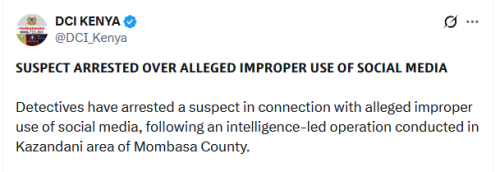
“Detectives have arrested a person of interest in connection with alleged improper use of social media, following an intelligence-led operation conducted in the Kazandani area of Mombasa County,” DCI stated.
“The person of interest was apprehended after investigations linked her to an X (formerly Twitter) account used to publish sensitive information relating to the movements of protected persons, an act currently under investigation as a potential threat to national security.”
Whereabouts of the woman
The agency said the suspect is currently in police custody, where she is undergoing processing ahead of her arraignment in court.

The DCI reiterated that while the Constitution guarantees freedom of expression, the right must be exercised responsibly and within the confines of the law.
“The Directorate of Criminal Investigations (DCI) reminds members of the public that while the Constitution guarantees freedom of expression, this right must be exercised responsibly and within the confines of the law,” the statement read.
Computer Misuse and Cybercrimes (Amendment) Bill, 2024
This comes months after President William Ruto assented to the Computer Misuse and Cybercrimes (Amendment) Bill, 2024, on Wednesday, October 15, 2025.
The said illegal activities include those touching on child pornography, terrorism, and extreme religious or cultic practices.
The new law, which has far-reaching ramifications, henceforth gives courts and investigative agencies the legal authority to block websites hosting illegal content, order their closure, and compel offenders to remove harmful material.

The new powers follow the introduction of Section 46A, which grants courts broad authority to order the deletion of content from digital devices or websites, shut down offending platforms, and approve urgent intervention in suspected cases.
Under this provision, investigators will no longer need to wait for harm to occur, as they now have the power to move to court to seek authority to rein in on offensive areas before illegal content spreads or goes viral.
“Where an authorised person believes that a computer system, website, or digital device is being used to promote illegal activities, child pornography, terrorism, or extreme religious and cultic practices, the authorised person may apply to court for an order for the removal of the content or materials from the computer system, website, or digital device,” the law reads.
It adds, “Computer misuse refers to the unauthorised use, modification, or access to a computer system, program, or data; and cybercrime refers to an offence committed through the use of information and communication technology to target networks, systems, data, websites, or technology, or to facilitate a crime.”