CS Kagwe rallies agricultural agencies to cut food imports as new performance contracts signed
By Mabonga Makhanu, April 8, 2026Kenya has intensified its push to reduce food imports and strengthen domestic production.
Agriculture and Livestock Development Cabinet Secretary Mutahi Kagwe has called on State agencies to deliver measurable results that will transform the country into a net food exporter.
Speaking during a high-level consultative meeting with state agencies under the ministry and the signing of the 2025/26 financial year performance contracts in Malindi, Kagwe set a firm tone, framing food imports as a costly economic leakage the country can no longer sustain.
“This country spends billions of shillings importing food that we have the capacity to produce locally. We cannot afford to continue exporting jobs and opportunities through imports,” Kagwe said.
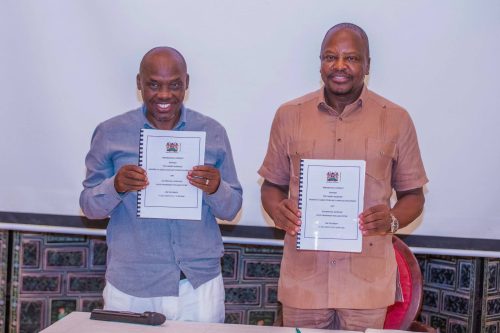
The meeting, which brought together both Principal Secretaries for Agriculture Kipronoh Ronoh and Livestock’s Jonathan Mueke, Board Chairpersons, Chief Executive Officers and senior Ministry officials, marked a critical accountability moment for Semi-Autonomous Government Agencies (SAGAs), with the CS demanding a clear scorecard of progress against targets agreed in the previous year.
Food imports
At the heart of this year’s deliberations was a sharpened theme, “Food imports: necessary interventions”, signalling a strategic shift toward import substitution and export-oriented agriculture.
Kagwe revealed that over 7.2 million farmers have already been registered under the Kenya Integrated Agricultural Management Information System (KIAMIS), enabling targeted distribution of subsidised inputs such as fertiliser and seeds during the current long rains season. He urged farmers to take full advantage of the programme to boost productivity.
“We have put in place systems to ensure farmers access inputs efficiently. What is required now is increased production and commitment across the value chains,” he noted.
The CS also challenged young Kenyans to take up opportunities in agriculture, describing the sector as a vast ecosystem with untapped potential across technology, logistics, and value addition.
The signing of the 2025/26 performance contracts underscored the government’s renewed focus on results-driven public service, with agencies committing to specific targets aligned to national priorities under President William Ruto’s Bottom-Up Economic Transformation Agenda (BETA).
CS Kagwe emphasised that performance contracting remains a key government tool to enhance efficiency, accountability and service delivery, warning that agencies will be held both individually and collectively responsible for outcomes.
“We must go beyond processes and ask ourselves what real impact we are having on the social and economic wellbeing of Kenyans,” he said.
He highlighted major gains made in the sector, including the digitisation of farmer data through KIAMIS and continued investments in livestock, which contributes over Ksh450 billion annually to the economy through products such as milk, meat and poultry.
Revenue generation

At the same time, Kagwe acknowledged persistent structural challenges facing several state agencies, including governance issues, wage pressures, pending bills, and overlapping mandates. He assured institutions of government support while urging them to strengthen internal revenue generation and adopt prudent financial management.
“There is no room for inefficiency. Every shilling must translate into impact,” he said.
The CS further called for stronger collaboration between boards and management teams, stressing that sound corporate governance and institutional harmony are critical for delivering results.
He also directed agencies to align with the government’s inclusive economic agenda by creating opportunities for youth, women and persons with disabilities, including outsourcing selected services to youth-led enterprises.
Looking ahead, Kagwe linked the sector’s transformation to Kenya’s broader Vision 2030 ambitions, emphasising the need for value addition, commercialisation and modern agricultural practices.
“Our institutions are the engines through which this transformation will be realised. Each agency must understand its mandate and deliver with precision,” he said.
Malindi meeting
The Malindi meeting also provided a platform to address emerging regulatory changes, including the implementation of the Government-Owned Enterprises Act, 2025, with representatives from the Attorney General’s office and the National Treasury present to guide agencies through the transition.
Kagwe concluded with a strong call to action, urging agencies to prioritise high-impact projects, complete pending initiatives, and focus on interventions that deliver quick, tangible results for farmers and consumers.
“This is a defining moment for our sector. The expectations are clear: improved service delivery, increased production, and real economic impact for the people of Kenya,” he said.
The performance contracts signed are expected to serve as binding commitments, anchoring the ministry’s push to reposition agriculture as a driver of jobs, food security, and economic growth.