Advertisement
Blast survivors long cry for justice
Monday 07th August, 2023 05:00 AM|
August 7, 1998, a Friday to be precise, started as an ordinary day for Enock Oroo.
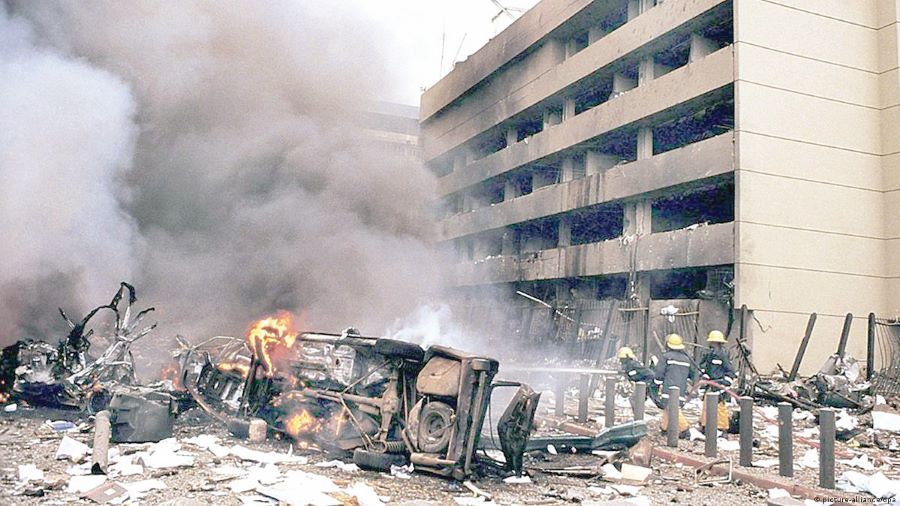
At around 10.30am on a day punctuated by an overcast sky, he was seated in a matatu on Haile Selassie Avenue, a stone’s throw away from the US embassy in Nairobi.
Oroo was headed to the railways terminus, some 400 metres away, where he had some few errands to run. Then all over a sudden, his world turned upside down. It was as if doors to his life had been blown off their hinges.
In his own words, Oroo, in an uneasy overtone, said he was not fazed by the sound at first. His line of thinking at that juncture was that it was a tire burst on the usually busy street.
Then within a split of a second, he felt the unmistakable force of a detonation nearby. He would later learn that the first sound was a grenade that was thrown at the guards outside the embassy.
Second sound
One thing led to another with the second sound from a truck laden with explosives blaring out.
Rightly so, he was certain that the worst possible thing had happened or was likely to happen.
The only thing he recollects from that day is that he woke up in hospital staring blankly at the white ceilings.
“I was from Nairobi West heading to town. It was just a normal day for me since I never expected anything tragic could happen. The calamitous incident really changed my life. I have been confined to a life of being in and out of hospital. I still have blemishes on part of my body from the incident,” says Oroo.
He reminisces that the tragic turn of events left him with one eye and his body still has some disfigurement he has been unable to rectify. “I may look fine but I am not in the true sense of the word. Fending for my family is still a tall order. I don’t have a stable job despite my family hanging on to me as a potential bread-winner,” he says.
As the country celebrates the blast memorial day today, the physical and emotional scars from Kenyans affected by the bomb blast are yet to heal.
Douglas Sidialo, spokesperson for the bomb blast victims, has knocked on almost every door in Kenya and abroad, seeking for every nook and cranny to have the victims compensated to no avail.
“The US had released some money primarily to restore the affected structures. Though a small fraction went to a medical support programme, including mental health for those who needed it, this was not an official compensation. The Americans simply packed their bags and left, leaving the victims distraught,” he says.
Sidialo, who was rendered totally blind, has met some top American Government officials and participated in numerous sports events to raise awareness about suffering the survivors are undergoing.
In one visit to America, he laid a wreath at the Pentagon, the US military headquarters after cycling from Ground Zero in New York with the brother of one of the pilots of the hijacked planes during the 9/11 attacks.
“I have cycled from Cairo to Cape Town in a mind-boggling 95 days of exercise. I have joined 10,000 cyclists in Tel Aviv for similar purposes. I have taken the trouble of climbing the tallest mountain in Africa (Kilimanjaro) to try and bring justice to victims. I have done what is humanly possible despite my circumstances….,” he says.
But nothing pains Sidialo more than the insensitivity of the US despite ‘lofty promises’ of restitution. In 2011, Sidialo met with then Secretary of State Hillary Clinton, who, like others before her, promised to ‘leave no stone unturned’ until the victims were compensated. Safula Mwilu lost her husband during the blast. The distressed widow was then working as a manager at a local bank adjacent to the embassy when the terrorists attacked.
Moving narrative
Giving a moving narrative of the events of the day, Mwilu said her husband was back in the office after suffering a stroke. Hopefully he had recovered from the ailment.
Mwilu had accompanied him but left to go and pick his clearance report from the hospital on the fateful day. Little did she know that this was the last time she would see her husband with whom she was bound in matrimony for several years.
However, all is not lost as the survivors have formed a lobby group dubbed ‘Consortium of the 7th August 1998 Victims’ which is currently engaging the Kenyan Senate for compensation.
Chairperson of the lobby Caroline Muthoka said part of their agenda is to push for what the USA government was supposed to pay them.
“Senate is expected to expedite ways in which the US government can be moved to amend its laws to allow for eligibility of compensation to the Kenyan victims and survivor’s. “The consortium is calling on all persons of goodwill to help advance this noble and just fight to ensure justice for survivors, and families of the victims of the 1998 bombing secure the long awaited compensation and enable them to lead normal lives,” says Muthoka.
The lawmakers are set to establish a nine-member committee to push the US and Kenyan governments to pay the victims. “The Senate has resolved to establish an ad hoc Committee to engage the Ministry of Foreign Affairs to advance friendship and cooperation between the US and Kenya,” Machakos Senator
Agnes Kavindu said recently. In a motion set to be approved by the House, the proposal is meant to support the eligibility of Kenyan and American victims and their personal representatives, surviving spouses and next of kin in the Victim Compensation Fund.
Most survivors revealed that they still have particles of glasses in their bodies while others have to survive on medication for the rest of their lives.
The near-simultaneous attacks against US embassies in Kenya and Tanzania on August 7, 1998, killed 224 people and injured more than 5,000.
Author
Alvin.Mwangi
View all posts by Alvin.MwangiLatest News

Advertisement
More on News