AU chair Youssouf: US–Iran deal shows power of dialogue in ending conflicts
By Sharon Atieno, June 18, 2026The Chairperson of the African Union (AU) Commission Mahmoud Ali Youssouf has welcomed the peace agreement signed between the United States and Iran, describing it as a major breakthrough that demonstrates the effectiveness of dialogue and diplomacy in resolving global conflicts.
Speaking in his X account on Thursday, June 18,2026, Youssouf said the agreement marks an important step toward ending hostilities, reducing tensions, and advancing lasting peace and stability in the Middle East.
“This agreement demonstrates the power of dialogue and diplomacy in resolving conflicts and building trust between nations. It offers renewed hope for peace, stability, and cooperation in a region whose security and prosperity have global significance,” he said.
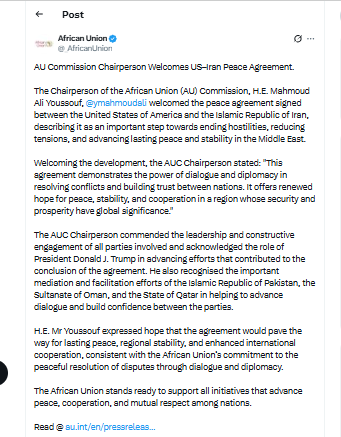
The AU Commission Chairperson commended the leadership and constructive engagement of all parties involved in reaching the agreement, noting that sustained diplomacy remains the most effective path to peace.
He also acknowledged the role of former US President Donald J. Trump in advancing efforts that contributed to the conclusion of the deal, alongside mediation efforts by Pakistan, Oman, and Qatar, which he said were instrumental in building confidence between the parties.
Youssouf expressed optimism that the agreement would pave the way for lasting peace, regional stability, and stronger international cooperation, consistent with the African Union’s long-standing commitment to peaceful dispute resolution.
He further reaffirmed that the AU remains ready to support initiatives that promote dialogue, cooperation, and mutual respect among nations.
US and Iran sign initial peace deal to end war
The comments come after the presidents of the United States and Iran signed an initial peace agreement aimed at ending the ongoing conflict, with the deal taking immediate effect upon signing.
The agreement includes reopening the Strait of Hormuz, a key global shipping route, alongside a reported $300 billion reconstruction plan for Iran and the lifting of US sanctions on Tehran.
However, the nuclear issue identified as a central point of contention remains unresolved and is expected to be negotiated over an extendable 60-day period.
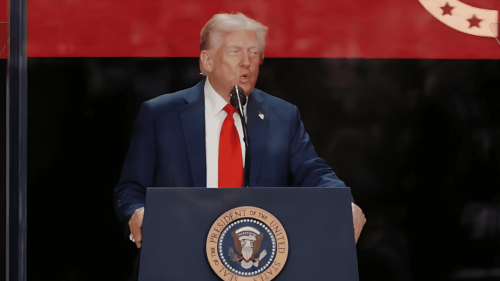
US President Donald Trump defended the deal, saying it was necessary to avoid a global economic crisis, while warning that failure to reach a final agreement could lead to renewed military action.
Iranian President Masoud Pezeshkian also signed the agreement, though Iranian officials maintained cautious skepticism, warning that their “finger is on the trigger” and expressing continued distrust of Washington.
The development marks a significant diplomatic shift in efforts to de-escalate tensions that had disrupted global energy markets and trade routes, including the Strait of Hormuz, through which a significant share of global oil and gas passes.