AMREF warns of rising malaria burden as funding shrinks
By Faith Lagat, August 19, 2025AMREF has sounded the alarm over an escalating malaria crisis, warning that rising cases combined with shrinking donor support threaten decades of hard-won progress.
The concern was raised during the Amref Global Fund Malaria Annual Stakeholder Review Meeting held on Tuesday, August 19, 2025, in Nairobi.
According to the 2023 World Malaria Report, global malaria cases rose from 252 million in 2022 to 263 million in 2023, with deaths hitting 597,000. Africa remains the hardest hit, accounting for 94 per cent of all cases and 95 per cent of fatalities. Children under five bear the greatest burden, making up 76 per cent of malaria deaths.
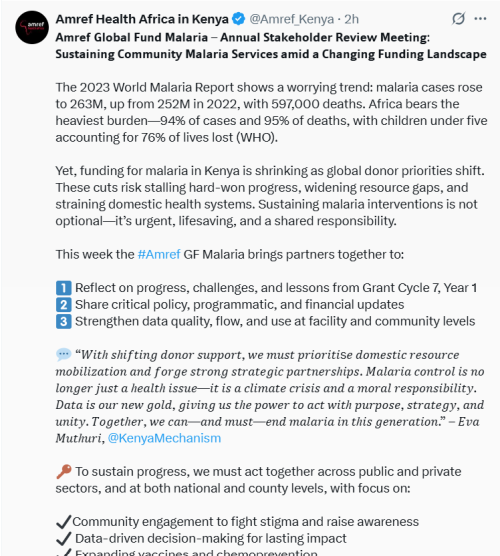
“The 2023 World Malaria Report shows a worrying trend: malaria cases rose to 263M, up from 252M in 2022, with 597,000 deaths. Africa bears the heaviest burden—94% of cases and 95% of deaths, with children under five accounting for 76% of lives lost (WHO),” read part of the AMREF statement on X.
In Kenya, where 70 per cent of the population is at risk, the situation is worsening as international donor support dwindles. Amref has warned that this decline in funding risks reversing gains made in recent years, widening resource gaps, and overstretching an already burdened health system.
“Yet, funding for malaria in Kenya is shrinking as global donor priorities shift. These cuts risk stalling hard-won progress, widening resource gaps, and straining domestic health systems. Sustaining malaria interventions is not optional—it’s urgent, lifesaving, and a shared responsibility,” it added.
Call for domestic solutions
The meeting, which reviewed progress and challenges under Grant Cycle 7, Year 1, emphasised the need for urgent domestic resource mobilisation. Partners shared lessons and updates on policy, financial, and programmatic interventions aimed at strengthening malaria control.
Eva Muthuri, speaking on behalf of the Kenya Coordinating Mechanism, urged for a paradigm shift in how malaria is tackled.
“With shifting donor support, we must prioritise local resource mobilisation and forge strategic partnerships. Malaria control is not just a health issue—it is also a climate crisis and a moral responsibility,” she said.
Muthuri added that the future of malaria control lies in leveraging accurate data. “Data is our new gold, giving us the power to act with purpose, strategy, and unity. Together, we can—and must—end malaria in this generation,” she stated.
Community-level action
Amref highlighted the importance of community engagement in combating stigma, raising awareness, and supporting access to life-saving interventions. The organisation called for stronger data use at both community and facility levels, describing this as essential for effective disease surveillance and response.
Other strategies outlined include expanding access to malaria vaccines and preventive medication, enforcing adherence to case management guidelines, and ensuring universal access to vector control measures such as treated mosquito nets and indoor spraying.
Climate change worsens burden
The organisation further pointed to growing evidence linking climate change to increased malaria transmission, warning that without sustained intervention, cases could rise even further.
Amref stressed that collaboration across national and county governments, private partners, and communities will be vital to turning strategies into measurable impact.
With global funding uncertainties looming, the organisation’s call to action underscores the urgency of innovative resource mobilisation and united efforts to secure a malaria-free Kenya.