Amref raises alarm as Kenya reports influx in Kala-azar infections
By Faith Lagat, January 31, 2026Amref Health Africa has raised concern over a surge in visceral leishmaniasis, commonly known as kala-azar, with more than 2,200 cases reported across Kenya in the past year.
The alert comes amid World Neglected Tropical Diseases (NTD) Day, observed on January 30. Kala-azar is a parasitic infection caused by different species of Leishmania protozoa, which is transmitted through the bite of infected female sand flies common in arid and semi-arid regions.
Rising cases in endemic counties
In a statement on January 29, Amref Kenya highlighted the urgency of early intervention, noting that delays in treatment can be fatal.
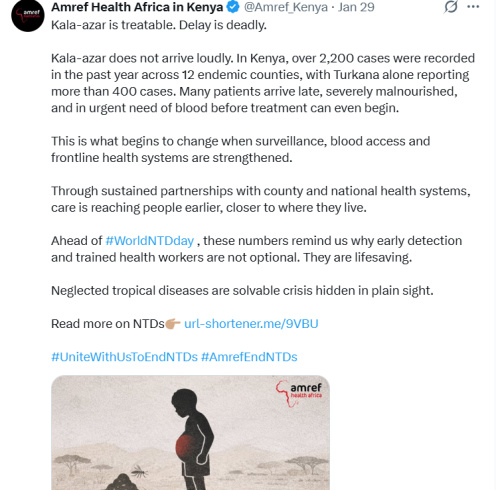
“Kala-azar is treatable. Delay is deadly. Kala-azar does not arrive loudly. In Kenya, over 2,200 cases were recorded in the past year across 12 endemic counties, with Turkana alone reporting more than 400 cases. Many patients arrive late, severely malnourished, and in urgent need of blood before treatment can even begin,” the organisation said.
Amref noted that strengthened surveillance, improved access to blood, and robust frontline health systems are beginning to improve outcomes.
“This is what begins to change when surveillance, blood access and frontline health systems are strengthened. Through sustained partnerships with county and national health systems, care is reaching people earlier, closer to where they live,” the statement read.
Importance of early detection
The organisation stressed the critical role of early detection and trained health workers. “These numbers remind us why early detection and trained health workers are not optional. They are lifesaving. Neglected tropical diseases are solvable crises hidden in plain sight,” it said.
Amref Health Africa is leading national efforts to control and eliminate several NTDs, including lymphatic filariasis, schistosomiasis, soil-transmitted helminthiasis, visceral leishmaniasis, and trachoma.
The organisation works with national and county governments to integrate NTD interventions into primary health care, in line with the WHO NTD Roadmap (2021–2030), Kenya’s NTD Masterplan (2023–2027), WHO East Africa VL Elimination Framework (2023–2030), and Kenya’s Universal Health Coverage agenda.
Targets at-risk populations
The National Programme for Eliminating Visceral Leishmaniasis (NPEVL) targets five million people at risk across 12 counties, including Baringo, Kajiado, Samburu, Turkana, West Pokot, Isiolo, Kitui, Garissa, Mandera, Wajir, Marsabit, and Tharaka-Nithi.
The programme focuses on rapid case detection, comprehensive patient care, and strengthened supply chains to address outbreaks linked to climate change and population movement.
Amref’s broader NTD strategy is based on three pillars: strengthening health systems using digital tools for real-time data, empowering communities through Community Health Promoters, and addressing root causes such as inadequate water, sanitation, and hygiene (WASH) coverage.
Other initiatives include the National Programme to Eliminate Lymphatic Filariasis in six coastal counties by 2030, the Deworming Innovation Fund targeting intestinal worms in four western counties by 2027, a nationwide assessment for schistosomiasis and soil-transmitted helminthiasis across 32 counties, and the Kenya Trachoma Elimination Programme, which covers 14 counties.