Advertisement
AMREF: Over 169K TB cases reported annually in Kenya
Saturday 30th August, 2025 01:40 PM|
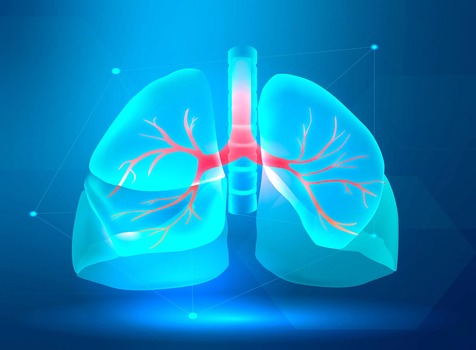
AMREF Health Africa has highlighted a growing public health concern in Kenya, where over 169,000 new tuberculosis (TB) cases are reported annually, yet more than 82,000 remain undetected.
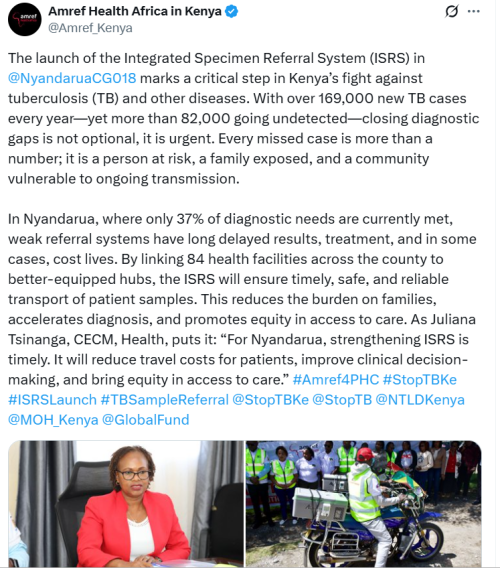
The alarming gap in diagnosis was underscored during the launch of the Integrated Specimen Referral System (ISRS) in Nyandarua County on August 30, 2025. The initiative aims to strengthen the country’s fight against TB and other diseases by addressing long-standing diagnostic challenges that delay treatment and containment.
“With over 169,000 new TB cases every year—yet more than 82,000 going undetected—closing diagnostic gaps is not optional, it is urgent. Every missed case is more than a number; it is a person at risk, a family exposed, and a community vulnerable to ongoing transmission, “read part of the AMREF post.
Diagnosis
The ISRS, spearheaded by Amref, connects 84 health facilities across Nyandarua to advanced diagnostic hubs. In a county where only 37% of diagnostic needs are currently met, weak referral systems have caused delays in test results and treatment, sometimes costing lives. Amref emphasized that “every missed case is more than a number; it is a person at risk, a family exposed, and a community vulnerable to ongoing transmission.”
You Might Also Like



The new system ensures timely, safe, and reliable transport of patient samples, easing financial and logistical burdens on families. Juliana Tsinanga, CECM for Health, noted, “Strengthening ISRS is timely. It will reduce travel costs for patients, improve clinical decision-making, and bring equity in access to care.”
National and international support
The initiative builds on years of national and international collaboration. The U.S. Centers for Disease Control and Prevention (CDC) has partnered with Kenya since 2004 through PEPFAR, enhancing surveillance, laboratory systems, and service delivery for TB and HIV. CDC supports 89 accredited labs and conducts over 900,000 TB tests annually, with integrated sample referral networks complementing the ISRS.
Additionally, Kenya secured Ksh 59.7 billion in Global Fund grants in June 2024, with USD 67.7 million earmarked for TB over three years. These funds aim to strengthen interventions, reduce incidence, and improve health system capacity.
Persistent public health threat
Kenya continues to make progress, with a TB treatment success rate of 89% and a declining positivity rate. However, with a TB incidence of 223 per 100,000 and 26% of cases co-occurring with HIV, initiatives like the ISRS remain critical.
By enhancing diagnosis, reducing delays, and linking facilities to better-equipped hubs, the launch is a decisive step toward ending TB as a public health threat, safeguarding lives, and promoting equitable access to healthcare.
Author
Latest News






Advertisement
More on News