Through the lens: Photographers recount Kenya’s June 2024 protests
By Lucky Oluoch, June 25, 2025The June 2024 protests were untrodden paths in the history of our motherland, Kenya. The older generation – and mostly the younger generation, Gen Z – said enough is enough, and they all came out in large numbers to fight for Kenya and save it from the jaws of the predators.
Then orders were issued, and the men in blue, the same ones tasked with maintaining law and order, turned trigger-happy and went berserk, firing live bullets at peaceful protestors who were neither armed nor a threat.
They just had the national flag, water, and their phones in their hands. The police gunned down many of them and injured even more. They did all this right in front of cameras without batting an eye.
Not until that period in time did I keep on bumping into Lucas Onyango, Karali Ramadhani and Abdiwahid Kadir (all photographers), all of whom were always doing their best to tell stories through every click of their shots.
They not only documented every single bit of the revolution to tell stories of the monumental period, but also, their shots came in handy when Kenyans wanted to piece together information in a bid to call out rogue police individually and hold them to account.
However, each one of them, like every other Kenyan, has a personal story to tell about their June 2024 ordeal. Tales from the moment they stood in the line of fire to capture history in real time as they risked to show the whole world what courage, resistance, as well as loss, look like up close.
Fun at first
Lucas Oyugi says that when taking part in the protests, it was all fun.
“Strange to say, but it is the truth. There was something electrifying about the first days. Like… we were all meeting offline, unmasked, unfiltered and united by a shared rage,” he says.
He notes that he went to the streets on June 18, 2024, with a borrowed Nikon D3400 camera. He had no press card. No helmet. No goggles. Just guts, alongside his photographer friends from Kibera.
“Most of us were amateurs. But purpose has a way of making you brave,” he says.
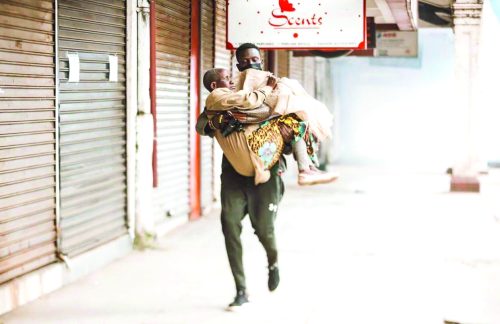
The day was mostly peaceful, but when it clocked midday, it seemed like hell burst open as it was around that time that a teargas canister was lobbed towards their direction, from a fast-moving police car, while they were along Kenyatta Avenue.
“It landed next to an old woman. She was holding a small plastic cup with a few coins. And it is then that I noticed that she was a blind beggar, alone in what had turned into a warzone.”
Then, all of a sudden, the canister exploded like a bomb. Screams. Chaos. Fear swept through like wildfire, and within seconds, everyone bolted in every direction.
Oyugi says that he dashed towards her and carried her like a child.
“I did not know her or how she even got there. All I knew was that she was human and she needed help,” he notes.
“That moment changed everything. That photo of me carrying her to safety became one of the most defining moments of my life. It wasn’t about heroism. It was about duty.”
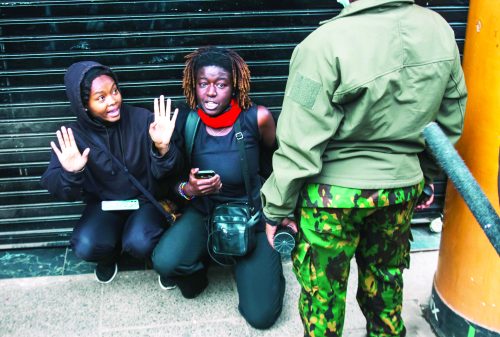
Later that same day, when he thought that he had witnessed enough, he again saw a police officer lose his arm from mishandling a canister.
“That was the first time I saw blood. The first time, the protest didn’t just feel symbolic; it felt real. After that, I kept going back. Even when I saw the wounded. Even when I photographed the dead. Every time I went to edit, it felt like dragging those bodies back into my room. Choosing which image stood out felt like a betrayal because all of them mattered. But I kept showing up. Because this was bigger than fear,” he quips.
He says that there is one photo he cannot forget. A photo of a young protester shot, bleeding, being rushed on a makeshift stretcher.
“Even through the pain, he raised his fist and shouted ‘Aluta continua!’. That’s the spirit I carry with me. That’s the spirit I shoot with.”
“One year later, a lot has changed. I’ve exhibited my work. I’ve found my voice. I’ve learned that photojournalism isn’t about neutrality. It is about bearing witness with courage. To those we lost, I carry your memory in every frame. And to that woman I carried, I may never know your name, but you showed me what it means to see,” he notes.
Running on adrenaline
Karali Ramadhani is not new to protest scenes as a photographer. However, he says that covering the June 2024 protests was something else. It had him continuously running on adrenaline.
He experienced frequent anxieties, not knowing if the next second would bring teargas, a beating, or worse… death. And yet, he says, there was a strange joy.
That which you feel because of being in the middle of something real, raw and monumental.
In as much as he felt the strange joy, Ramadhani avers that editing the photos from the protests broke him inside. That is the time, he says, the screams came back to him, the blood flashed in his mind in full colour, and the ear-deafening bangs made his heart race.
A screeching car almost sent him jumping out of his skin. He got shook to the core.
“Thankfully, within our circles, we have built some level of support. Peer-to-peer counselling, long conversations with fellow creatives, and even just silence together. It does not fix everything, but it helps you breathe,” he notes.
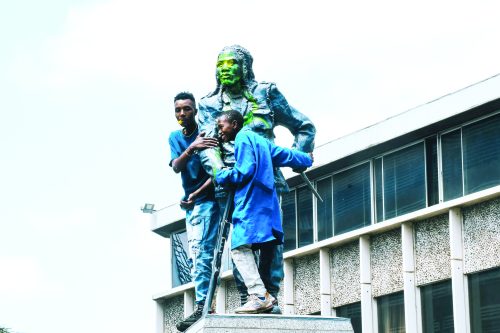
He says that he took part in the June 2024 protests because he wanted to “humanise the protestors”.
He adds, “Not as angry youth or faceless crowds but as Kenyans. As dreamers. As people who believe their country can do better. I wanted to document not just the chaos but the courage. The moments of defiance, of care, of resilience. The handwritten placards. The shared water bottles. The strangers become family under fire. I needed people to see them. To feel their pain and power. Because once we begin to see each other as people, change becomes inevitable.”
One year later, he reflects, “I’m just grateful to be alive. Many of us had close calls, some physical, and many of us mentally. But more than anything, I reflect on how something changed in this country. People became engaged, curious, angry, yes, but constructively so. We now live in a moment where everyone is a storyteller. Everyone’s footage matters.
Excitement and pride
Everyone’s voice adds to the archive. That period taught me that the power of visual truth is no longer in the hands of a few. It’s collective now, and that gives me hope.”
Like thousands of brave souls on the streets in June 2024, Abdiwahid Kadir was filled with excitement and pride as he documented a monumental period for our country. However, he similarly faced his fair share of challenges.
He states, “I wasn’t working for any media house, just freelancing, trying to capture amazing moments. The other challenge was that I didn’t have any protective gear while covering the protests, and that really hit home when I came face to face with a policeman wearing civilian clothes and covering his face with a mask, pointing a gun at me.”
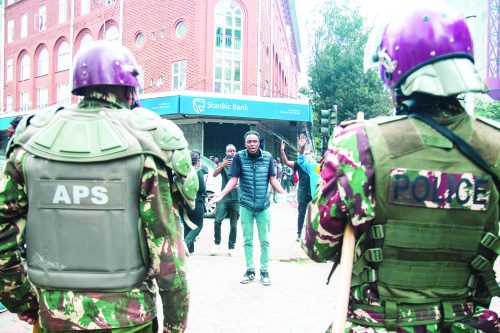
“It was a scary moment that traumatised me. I wanted to go home after that, but other journalists encouraged me to continue covering the protests and not let anyone scare me,” he adds.
Police going rogue and moments when he saw people getting shot, he says, traumatised him to the point that he almost forgot he was supposed to document the moments.
“It was running battles where you had to be careful about the goons, the police, and the thieves who wanted to harm you or steal from you. At the end of the day, you thank God because you made it out alive, but scarred for life,” he says in conclusion.