Ten mega infrastructure projects in Africa
By Barry Silah, September 1, 2020By 2050, Africa’s population could balloon to 2.4 billion people according to United Nations estimates. However, the average age of that population will be much lower than the rest of the world. This is called the “youth bulge”. It means Africa has the opportunity to benefit from a massive and dynamic workforce eager to build a new future. Nations are investing in various mega-projects hoping to support this growth sustainably. Here are some ambitious projects currently in development:
1. Lagos-Calabar Railway
Set to cost $11 billion (Sh1.2 trillion), the 1,400-kilometres long Lagos-Calabar railway is being hailed as one of Africa’s most ambitious projects.
The rail project will link Lagos in the west to Calabar in the east while connecting the cities of Port Harcourt, Uyo, and Aba along the way.
Once complete, it will enhance the movement of goods and services across the region. The Lagos – Calabar Coastal Railway Project Will Run Through Calabar – Uyo – Aba – Port Harcourt – Yenogua – Otuoke – Ughelli – Warri – Sapele – Benin – Ore – Ijebu-Ode – Lagos targets to cover all seaports along those routes soon.
The railway project is run by the China Civil Engineering Construction Company.
2. Grand Ethiopian Renaissance Dam
In the Benishangul-Gumuz region of Ethiopia, this $4.8 billion (Sh480 billion) project has been in the works since 2011 and is scheduled for completion in the mid-2020s.
It will then take another five to 15 years for the reservoir to fill with water. But once fully activated, the Grand Ethiopian Renaissance Dam will generate 6,450 MW of power for Ethiopia and neighboring countries, and will also be recognized as the largest hydroelectric power plant in Africa, as well as the seventh largest in the world.
The primary purpose of the dam is electricity production to relieve Ethiopia’s acute energy shortage and for electricity export to neighbouring countries.
3. TuNur solar park
Leading the way into the future, TuNur is building a massive, 4.5GW solar energy park in Tunisia, over an area three times the size of Manhattan, New York.
By absorbing the energy directly from the Saharan sunshine, this project will then export electricity to Malta, Italy and France using submarine cables, powering up to two million European homes.
TuNur solar project in Tunisia is a joint venture between Nur Energy, a solar plant developer based in the UK, and a group of Maltese and Tunisian investors in the oil and gas sector.
This project in particular involves massive land grabs (10,000 hectares) as well as extensive water usage to clean and cool the panels in arid and semi-arid regions to export energy to the UK and Europe.
4. Mambilla hydroelectric power project
As Nigeria aspire to boost its energy production to match the needs of its booming economy and increasing population, the government has finally invested to make the mega Mambilla Hydroelectric Power Project a reality.
Over three decades in planning, this $5.8 billion (Sh580 billion) project will connect to three dams across the Donga River in Taraba State, eventually generating a total installed capacity of 3,050MW of electricity.
Nigeria’s Federal Ministry of Power, Construction and Housing, with the help of Chinese investments, is undertaking the project.
Expected to commence operation in 2030, Mambilla will be Nigeria’s biggest power plant, producing approximately 4.7 billion kWh of electricity a year.
5. Suez Canal Expansion
Since 2014, the expansion of the Suez Canal has been underway to add 22 miles to the Suez Canal in a new shipping lane beside the original 102-mile canal. Once completed by 2023, this expansion is expected to double annual revenue with the room for added ships.
The project involved building a new city (new Ismailia city), an industrial zone, fish farms, completing the technology valley, building seven new tunnels between Sinai and Ismailia and Port Said, improving five existing ports, and digging a new canal parallel to the Suez Canal.
The new canal has increased the canal capacity by allowing ships to sail in both directions at the same time for a greater proportion of the canal.
The project transformed the canal cities into an important trading centre globally.
It also built new centres on the Suez Canal for logistic and ship services. The project’s authority said that the revenues of the canal would increase from 5 billion dollars (Sh500 billion) to 12.5 billion dollars (Sh1.3 trillion) annually.
6. Mombasa–Nairobi Standard Gauge Railway
Kenya is investing Sh326 billion to set up a 969-kilometre standard gauge railway from Mombasa to Malaba.
This project is vital because only 5 per cent of the country’s shipping is currently done using freight, but once complete, this new railway will help to push that figure up to 40 per cent by 2025.
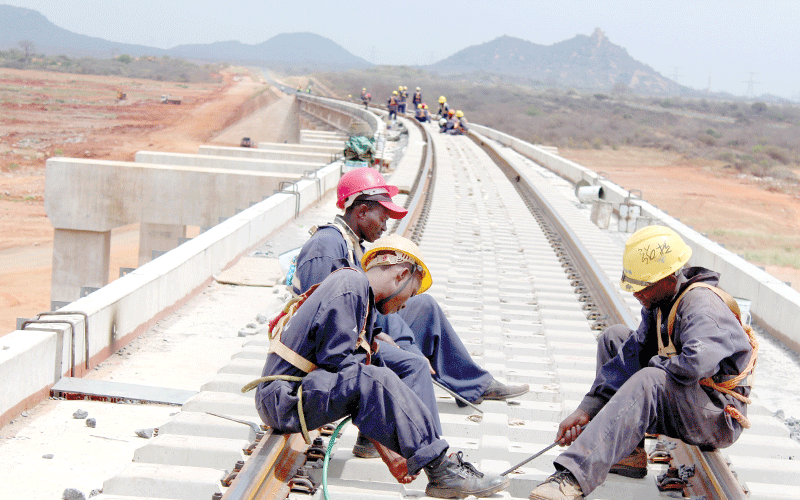
This new line will also cut travel time between the country’s two most important cities down to 4.5 hours, instead of nine hours by bus.
So far, the rail line from Mombasa has reached Naivasha.
7. Ambitious Grand Inga Dam
This project has been in the works since the 1950s and continues to find difficulties from financiers for the ambitious $100 billion (Sh1.08trillion) required to make it a reality.
However, once complete, the Grand Inga Dam could one day become the world’s largest hydroelectric dam, tapping into the mighty Congo River to generate an average output of 39,000 MW annually, twice as much as China’s Three Gorges Dam.
It is anticipated to support a series of hydroelectric power stations, each with generation capacity ranging from 4,000 to 8,000 megawatts for a total of 40,000 megawatts for the whole complex.
Inga III Power Station with capacity of 4,800 megawatts would be the first power station in the series, to be constructed.
8. Bagamoyo Port
Through collaboration between Tanzania, China and Oman, the ambitious Bagamoyo Port is being developed in Tanzania, along with 190 industries built in a 1,700-hectare special economic zone adjacent to the port.
With an initial investment of $11 billion (Sh1.2 trillion), this mega project is designed to become Africa’s largest port, capable of handling 20 million containers per year once it’s fully completed by 2045.
Without doubt, this project will position Tanzania as a regional economic powerhouse.
Set to be the largest government infrastructure project in the country, the project and its affiliate industrial zone is meant to address congestion at the old port with a leading shipping and logistics centre.
9. Konza Technology City
Kenya’s first smart city and one that is being purpose-built to attract technology workers and investors is already underway as the country banks on setting up the “African Silicon Savanna”.
With a budget of $14.5 billion (Sh146 billion), and located 64 km south of the capital Nairobi, Konza will work to diversify Kenya’s economic growth by establishing districts for business process outsourcing, disaster recovery centres, call centres, software development, data centres, light manufacturing industries, and research institutions.
Once complete and operational, Konza will create 17,000 direct, high-value jobs, along with 68,000 indirect jobs by 2030.
The Konza Technopolis will be a business process outsourcing (BPO) project that is being marketed by the Kenyan government through Kenya ICT Board.
10. Lekki Deep Seaport
In the Ibeju-Lekki axis of Lagos State, one of Western Africa’s largest infrastructure projects is being planned.
The Lekki Deep Seaport is a $1.2 billion (Sh12 billion) venture that is due for completion in 2021.
A multi-purpose, deep sea port at the heart of the Lagos Free Trade Zone, Lekki Deep Sea Port will be one of the most modern ports in West Africa, offering enormous support to the burgeoning commercial operation across Nigeria and the entire West African region.
Louis Berger, one of the largest multi-disciplinary infrastructure-consulting firms in the world, is the project management consultant on the multi-billion shilling Lekki Deep Sea Port Project.