Lasting peace in Kerio Valley demands both security and development
By Faith Lagat, July 27, 2025The Kerio Valley, straddling Baringo and Elgeyo Marakwet counties, remains one of Kenya’s most naturally endowed regions—rich in tourism potential, mineral resources, and agricultural productivity.
Yet for decades, its promise has been undermined by insecurity. Banditry, cattle rustling, and ethnic clashes have turned this picturesque landscape into a battleground, robbing communities of development opportunities and peace of mind.
Recent government efforts, especially under Operation Maliza Uhalifu, have brought much-needed stability to parts of the region. However, as Interior Cabinet Secretary Kithure Kindiki emphasised during recent Jukwaa la Usalama engagements in the North Rift, the road to lasting peace lies not only in military operations but also in sustained development and inclusive governance.
Are security operations enough?
Baringo County continues to attract local and international tourists thanks to its scenic views and natural attractions. However, insecurity in areas like Tiaty has remained a thorn in the side of progress.
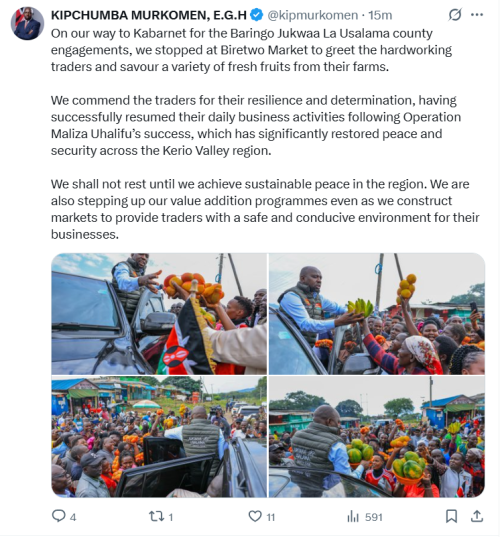
The government’s multi-agency operation—Maliza Uhalifu—has led to significant gains. Schools have reopened, businesses are bouncing back, and traders in places like Biretwo Market are slowly regaining confidence.
“We commend the traders for their resilience and determination, having successfully resumed their daily business activities following Operation Maliza Uhalifu’s success, which has significantly restored peace and security across the Kerio Valley region,” said the Interior CS.
Elgeyo Marakwet, known for its agricultural productivity and international athletics talent, has also seen a decline in violence, although pockets of unrest persist. Kindiki noted that of the county’s 20 wards, insecurity has largely been confined to sections of three wards along the valley belt. Areas like the Tot Division, previously paralysed by attacks, are now on the path to recovery with the return of civil servants, religious leaders, and local traders.
But security operations, no matter how successful, are only a short-term fix if not accompanied by deeper interventions. The roots of conflict—land disputes, marginalisation, poverty, and youth unemployment—require long-term development strategies.
Bridging the gap
The Interior CS was clear: “This must involve development.” His message was not just about disarmament but about building a new social contract in the Kerio Valley. To foster investor confidence and open up historically neglected areas like Tiaty, the government is constructing security roads and building more police stations. These efforts aim to improve mobility, enhance service delivery, and signal the state’s presence.
Markets are also in the pipeline. Establishing trading centres in remote and previously insecure zones will not only provide safe spaces for commerce but also create vital economic lifelines for families affected by conflict. In Elgeyo Marakwet, the government is working closely with the county and Ministry of Lands to expedite land adjudication and issue title deeds. Land remains a key source of tension, and resolving ownership disputes could dramatically reduce inter-community hostilities.
Development programmes must go further. The Interior CS acknowledged the worrying rise in illicit alcohol and drug abuse—an issue often tied to hopelessness and idleness among youth. Combating this requires not just arrests and crackdowns, but meaningful alternatives. Vocational training, agricultural extension services, and access to capital for small enterprises must form part of the region’s recovery plan.
Elgeyo Marakwet’s agricultural strengths, for instance, can be amplified through irrigation schemes and value addition, creating jobs while boosting food security. Youth-targeted initiatives that build local industries—be it in honey processing, livestock rearing, or ecotourism—could tip the scales in favour of peace.
Community-led peace
Operationalising more administrative units is another step in the right direction. In Elgeyo Marakwet, the Interior CS announced plans to activate six new divisions, with the aim of improving coordination, bringing government services closer to residents, and enhancing trust between the state and communities. When people feel seen, heard, and served, they are less likely to resort to violence.
Still, security agencies themselves must be beyond reproach. The Interior CS did not mince words when he warned that civil servants and police officers found abetting the sale of illegal arms or illicit brews will face the full force of the law. Restoring law and order cannot be selective—there must be accountability across the board.
Equally important is the human side of peacebuilding. The Kerio Valley is home to diverse ethnic communities, including the Pokot, Tugen, and Marakwet, all of whom bear historical grievances that cannot be ignored. Programs led by elders, religious leaders, and youth groups must be empowered to foster dialogue, resolve long-standing feuds, and promote inter-community collaboration.
National efforts like those of the National Cohesion and Integration Commission (NCIC) should be localised and expanded in this region. Peace committees, trauma healing initiatives, and civic education campaigns are necessary complements to guns and bulldozers.
Education and healthcare must also be central to the peace process. The reopening of learning institutions in Tot is welcome, but more must be done to ensure that children in Kerio Valley have access to quality education. School feeding programs, scholarships, and mobile clinics can go a long way in restoring public confidence and keeping communities intact.
The government’s stated commitment to sustainable peace in the Kerio Valley must now be matched by consistent funding, transparent implementation, and public participation. Lessons can be drawn from other formerly volatile regions where investment in livelihoods and infrastructure helped turn the tide.
New chapter for the valley
The Kerio Valley does not have to remain a symbol of conflict and lost potential. With a coordinated approach that balances firm security measures and people-centred development, this region can be transformed into a beacon of peace, prosperity, and resilience.
The words of the Interior CS must now translate into sustained action. Roads must be completed, markets built, weapons surrendered, and children sent back to school. Communities must be given a reason to hope, to believe, and to invest in peace.
The challenges are immense—but so is the potential. It’s time for Kerio Valley to write a new chapter.