Kenya’s youth tobacco surge: A call for local action
By Faith Lagat, August 16, 2025Kenya has made notable progress in reducing adult tobacco use, dropping from 11.6 per cent in 2014 to 8.5 per cent in 2022, according to the Tobacco and Alcohol Drugs Survey (TADSAS).
Yet this success masks a worrying trend among adolescents, with over 650,000 young Kenyans experimenting with tobacco and nicotine products. The rise of flavoured nicotine pouches, delivering nicotine levels comparable to cigarettes, is particularly alarming.
These products, often marketed as “safer” alternatives, appeal to youth while posing serious risks to oral health and brain development. As highlighted at the #DevolutionConference2025, urgent, localised interventions are needed to shield the nation’s young people from a growing public health crisis.
Counties must lead localised responses
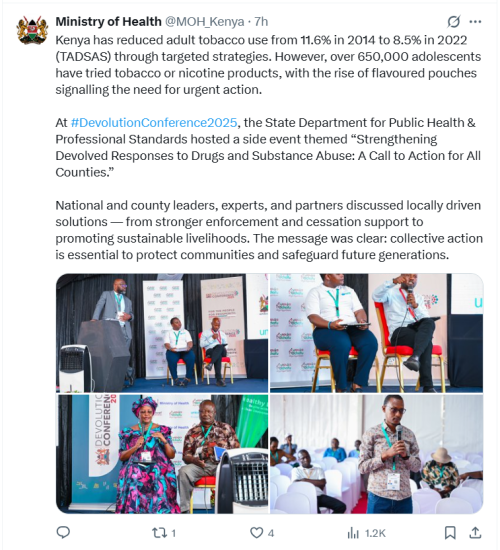
During a side event at the conference themed “Strengthening Devolved Responses to Drugs and Substance Abuse”, the State Department for Public Health & Professional Standards convened national and county leaders, experts, and partners to discuss targeted strategies.
The discussions emphasised that counties are best placed to design interventions suited to their specific contexts, given the varied drivers of youth tobacco use—accessibility, marketing, and socioeconomic factors.
Health Cabinet Secretary Aden Duale has taken decisive steps to curb supply, announcing a ban on tobacco product imports on July 30, 2025. This move targets products flooding the Kenyan market from countries such as China, aiming to limit youth access.
Complementing this, Legal Notice No. 107 of 2025 introduced graphic health warnings illustrating the risks of tobacco use—cancer, heart disease, and respiratory illness—in ways that transcend literacy barriers. These interventions underscore a zero-tolerance approach; however, effective enforcement will require collaboration among NACADA, county governments, and other relevant agencies.
The Senate Committee on Delegated Legislation, meeting with Duale on August 5, acknowledged the Ministry’s efforts but stressed stakeholder engagement for effective implementation. Vice Chairperson Sen. Danson Mungatana highlighted the moral imperative to protect youth, even as economic trade-offs for the tobacco industry loom. Challenges such as corruption in enforcement, particularly around shisha, remain hurdles that must be addressed.
Tackling socioeconomic drivers
Beyond regulation, Kenya’s strategy recognises the link between tobacco use and socioeconomic conditions. In Migori County, a tobacco-growing region, Principal Secretary Mary Muthoni Muriuki led a sensitisation forum on July 17, educating farmers about the health and environmental risks of tobacco cultivation. Exposure to pesticides, soil depletion, and water contamination are well-documented, and the forum promoted safer, economically viable alternatives.
This approach also addresses youth substance use, often driven by unemployment and poverty. Evidence shows that tackling these root causes is essential in reducing initiation and supporting cessation. Coupled with efforts like Migori’s community education and localised livelihood programmes, counties have the potential to implement sustainable solutions that reinforce national policies.
Need for innovation
Globally, tobacco remains a leading killer. In 2023, it claimed over seven million lives, with men accounting for 5.59 million deaths and women 1.77 million, according to the Institute for Health Metrics and Evaluation. While some countries, such as the UK, have reduced tobacco-related deaths, global rates have risen by 24.4 per cent since 1990, with low- and middle-income nations disproportionately affected.
Economic costs are high, with tobacco-related expenditures reaching $555 billion in 2023 across countries such as Bolivia, Nigeria, and Paraguay—equivalent to one per cent of their combined GDP.
Kenya must also explore innovative interventions. AI-based mobile tools, trialled in China, doubled quit rates among smokers and could complement existing programmes. Raising tobacco taxes, as recommended by WHO, could generate resources for cessation support while discouraging youth use.
Yet, the tobacco industry’s aggressive marketing of new products like vapes and nicotine pouches threatens to undermine progress, highlighting the urgency of sustained enforcement and community engagement.
Local solutions remain paramount. Urban areas face challenges of marketing and accessibility, while rural tobacco-growing regions contend with economic dependency. Strengthening cessation and rehabilitation services, alongside community education, will be vital. Initiatives like Rachuonyo County Hospital’s near-universal health coverage demonstrate that sustainable financing can support these efforts.
Kenya stands at a critical juncture. Reducing adult tobacco use has been a major success, but the surge among youth signals a new front in the fight. Counties, empowered by national policies, must implement context-specific interventions while addressing socioeconomic drivers and enforcing regulations.
Only through a coordinated, localised response can Kenya safeguard its youth and secure a tobacco-free future.