Explaining Kenya’s sale of 15 per cent Safaricom stake to Vodacom
By Kenneth Mwenda, December 5, 2025The Kenyan government has announced plans to sell 15 per cent of its Safaricom shares to Vodacom Group for Ksh244.5 billion.
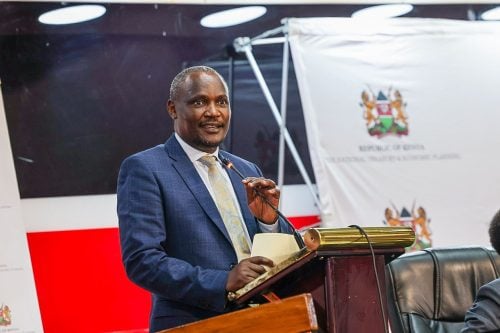
The move reduces the State’s ownership from 35 per cent to 20 per cent, while retaining two board seats. Treasury Cabinet Secretary John Mbadi said the sale is a divestiture of shares, not a sale of the company itself.
Vodacom will pay Ksh34 per share, a 20.6 per cent premium to the December 2 closing price of Ksh28.20. It is also 18.4 per cent above the 90-day volume-weighted average price and 33.9 per cent above the 180-day average.
Also watch: Mbadi dismisses Nyoro’s criticism over Safaricom stake sale
Mbadi said the government calculated the average share price over six months and added a premium. He added that a public offering on the Nairobi Securities Exchange would likely have fetched a lower price, around Ksh28 per share.
The sale includes conditions to protect Kenyan interests. Vodacom must consult the government before expanding outside Kenya. The Safaricom board chairman and CEO must be Kenyan citizens.
Local suppliers should remain largely unchanged for three years, and independent directors must always be majority Kenyan. These measures aim to safeguard operational continuity despite reduced government ownership.
In addition, Vodafone Kenya will pay the government Ksh40.2 billion upfront for the right to collect dividends on the remaining 20 per cent stake. This effectively monetises future dividends, providing immediate cash for the Treasury while pulling forward expected income.
The combined inflows from the sale and dividend monetisation reach Ksh244.5 billion, exceeding the FY25/26 privatisation target of Ksh149 billion.
Vodacom is also buying Vodafone’s remaining 12.5 per cent stake in Vodafone Kenya for Ksh68.1 billion. This consolidation removes cross-holdings and gives Vodacom 55 per cent of Safaricom indirectly.
The public float remains at 25 per cent, while strategic control is now clearly under one operator. Mbadi described this restructuring as a way to streamline ownership without affecting Safaricom’s day-to-day management.
Criticism over Safaricom sale
The transaction has attracted criticism. Kiharu MP Ndindi Nyoro said the government is underselling Safaricom. He pointed out that in August 2021, shares traded above Ksh45, valuing the company at Ksh1.8 trillion.

Selling at Ksh34 per share implies a valuation below Ksh1.4 trillion, a 24 per cent drop. Nyoro suggested that dividing Safaricom into three companies – the telecom, the tower business, and Safaricom Financial Services – could have produced a higher combined value.
Watch: MP Nyoro opposes Safaricom stake sale, says Kenyans are being short-changed
He also criticised the upfront dividend monetisation, describing it as mortgaging future earnings.
Mbadi rejected these claims, explaining that the value of shares is not the same as the value of the firm.
“If we were selling the company as a going concern, then you would value all assets and liabilities,” he said. “We are selling shares, not the company.”
He added that Vodacom, as an existing shareholder, can take on more risk than a new investor, which justified the negotiated sale and premium price.
The deal requires approvals from the Cabinet, Parliament, Capital Markets Authority, Central Bank of Kenya, COMESA, and the East African Competition Authority. Mbadi emphasised that the transaction will not disrupt Safaricom’s operations, and the company will continue business as usual.
In summary, the government is raising Ksh 244.5 billion immediately, reducing its stake in Safaricom to 20 per cent, and simplifying the company’s ownership structure. The government frames the move as non-tax revenue mobilisation, with proceeds serving as seed capital for the National Infrastructure Fund and the Sovereign Wealth Fund.