Advertisement
East Africa Community’s compelling shift on investment plans
Wednesday 24th August, 2022 05:29 AM|
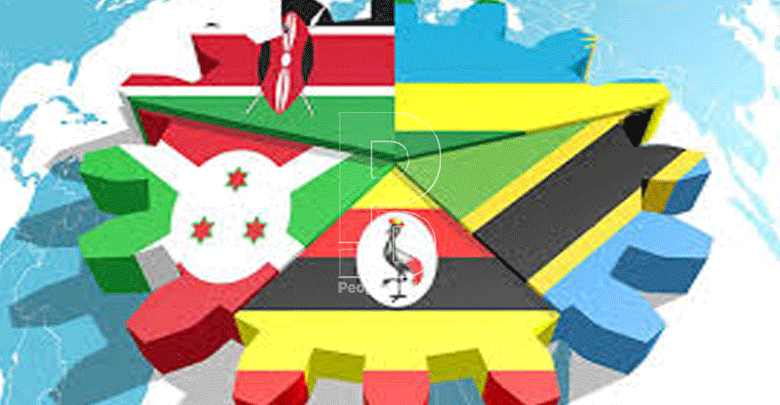
Parts of East Africa have been crucial to global trade for centuries. In fact, archaeologists have determined that some coastal settlements were part of the Indian Ocean trade network as early as the 7th Century. Today, the region offers opportunities that go far beyond trade. Investors should find it important to respond to these. In addition to opportunities in multiple sectors—agriculture, mining and tourism—the region has recovered well post Covid-19 and is expected to see 4.9 per cent average growth in 2022. It also has one of Africa’s most well-established and best-functioning trade blocs in Africa, the East African Community (EAC).
These factors combined, and others, mean the region has immense potential for any investor with the right approach. A good place to start when it comes to understanding the scope of available opportunities in East Africa is to understand what the EAC allows for, especially when it comes to regional investing. Connectivity, for instance?
The bloc—bringing together Burundi, Kenya, Rwanda, South Sudan, Tanzania, Uganda and DRC—representing a market of more than 300 million people and a combined GDP of $923.532 billion (Sh94 trillion).
Formed in its current guise in 2000, EAC launched a common market in 2010, allowing for the free movement of goods, labour and capital. This means a business in any of the countries has a much bigger potential market than that which exists within their individual borders. It also means they can draw on a much wider labour pool. These key factors are important to businesses, and by extension investors.
As the EAC continues to evolve—the body has outlined plans for launching a monetary union within 10 years—this will make investments in the region even more compelling.
The investment case will only grow stronger as the region continues to recover from Covid-19 and returns to steady growth. Prior to the pandemic, East Africa was Africa’s fastest-growing region, with an average GDP growth of five per cent. Additionally, three of the world’s top 10 fastest-growing economies in 2020 were in East Africa—Rwanda, Ethiopia and Tanzania.
While Covid and its lockdowns, travel restrictions and supply chain disruptions had an outsized impact on EAC and Africa, the recovery is promising. Of course, the region isn’t immune to global economic pressures such as inflation and product shortages caused by the Ukraine-Russia conflict, but many of the factors that fuelled its growth in the first place remain intact.
EAC, for example, has a young population with a median age of 18.7 years. As the equivalent median ages in developed countries continue to go up, the young people will form an increasingly important part of the global labour pool. They are also increasingly well educated and connected. Not only do they want the same consumption opportunities as global consumers but they are also capable of building global, technologically enabled businesses.
Finally, it is worth pointing out that people investing in East Africa can have an outsized impact. For all the region’s potential, it still has some way to go before fulfilling it.
Some 35 per cent of EAC citizens, for example, live in extreme poverty. South Sudan andBurundi have incredibly high percentages of these, at 85 and 80 per cent, respectively. This translates to an immense potential for investors to make an impact in high-employment sectors.
Additionally, as EAC grapples with climate change, investors can make an impact by focusing on businesses that are sustainable. There is a definite opportunity for businesses in the markets to take a sustainable approach from day one, putting them ahead of developed markets.
The best way to achieve this impact requires an approach that has Environmental, Social and Governance standards at its core. By aligning the standards with the UN Sustainable Development Goals, it becomes a lot easier to promote inclusive growth and address inequality while doing good for the planet.
While it might be too soon to suggest that East Africa really represents a new Eldorado,there can be no doubt that there are significant opportunities for investors. And, while it is important to acknowledge the realities of investing in the bloc, there is no doubt the opportunities will only keep growing, especially given the region continues to build enabling business environments. For investors, there will always be risks; with the right approach, the opportunities far outweigh them.
— Investment Director, Norsad Capital
Author
PD columnist
View all posts by PD columnistLatest News







Advertisement
More on Insights