Does WhatsApp really see your messages? The joke that sparked privacy scare
By Kenneth Mwenda, October 30, 2025In October 28, 2025, WhatsApp’s social media team posted what looked like a harmless joke.
“People who end messages with ‘lol’ – we see you, we honour you,” the company shared on X.
It was meant to be playful. But instead of laughs, it sparked panic.
For years, WhatsApp has built its identity around one promise: your chats are private. Since 2016, it has pushed end-to-end encryption as proof that no one — not even the company – can read messages. So when users saw the phrase “we see you”, many did not take it as a joke. They took it as a sign that WhatsApp might be watching.
The post spread quickly, amassing millions of views in hours. Online conversations shifted from humour to fear. People questioned whether the app, owned by Meta, had access to private chats all along. What began as a light quip about texting habits turned into a global debate: does WhatsApp really see your messages?
How the joke went wrong
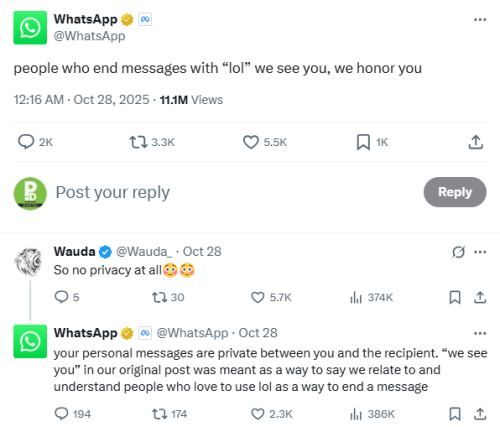
The tweet read:
“People who end messages with ‘lol’ – we see you, we honour you.”
It sounded like the kind of casual banter brands often use to appear friendly. But WhatsApp is not a clothing store or crisps brand. It handles deeply personal conversations – family chats, business deals, medical updates, private relationships, and even government communications.
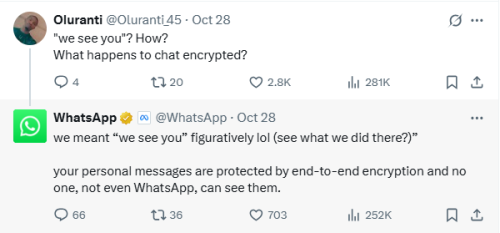
So when the phrase “we see you” appeared, many users did not giggle – they paused. Replies came in fast; So no privacy at all? End-to-end decryption. So it’s not encrypted then?
Some joked that the social media manager would lose their job. Others accused the company of being dishonest about encryption.
WhatsApp quickly responded to users:
“Your personal messages are private between you and the recipient. “we see you” in our original post was meant as a way to say we relate to and understand people who love to use lol as a way to end a message.”
The clarification helped calm things down, but the incident had already touched a raw nerve. One playful sentence had triggered a serious fear: that tech companies may be reading more than they admit.
This moment arrived in a climate of deep distrust. In recent years, people have seen data-harvesting scandals, the Cambridge Analytica misuse of Facebook data, major hacks exposing personal information, and public battles over government access to encrypted chats.
Users are no longer naive; they know tech platforms collect data and have watched privacy promises break before. So when a company built on privacy even jokes about “seeing” messages, trust wobbles. Trust in tech today is fragile, and one careless moment is enough to reopen old doubts.
What end-to-end encryption means
End-to-end encryption protects messages so that:
- Only the sender and recipient can read them
- No company, government, or third party can access them
- Encryption keys stay only on the users’ devices
In simple terms, a message leaves your phone locked, travels locked, and opens only on the other person’s device. That is why WhatsApp has always insisted it cannot read messages.
Can WhatsApp read messages?
Technically, with end-to-end encryption, it should not be able to. WhatsApp continues to say it cannot. No confirmed evidence says otherwise.
However, this incident proved something bigger: technical guarantees alone are not enough. People do not just want encryption — they want trust. And trust comes from belief, not code.
Brands try to be friendly online, but some subjects are not joke material. Banks do not joke about account safety. Hospitals do not joke about losing records. Messaging apps that promise privacy should not joke about “seeing” users.
Tone matters, and in privacy-focused spaces, humour can easily backfire; one sentence can create doubt, and doubt spreads faster than clarity. Scepticism toward tech is healthy – blind trust is not – but neither is panic over a joke.
The balanced approach is simple: pay attention, ask questions, expect transparency, protect your privacy, and avoid jumping to conclusions without evidence.
Even after the tweet fades away, the issue remains relevant. Messaging is now central to daily life. People share everything online – emotions, work, private decisions, relationships. Privacy is not a luxury feature. It is the foundation of communication.
When users ask, “Do you really protect my data?”, companies must answer confidently and consistently. One poorly judged joke can weaken years of trust-building.