Change Your Password Day: The small habit that could save you big trouble
By Faith Lagat, February 1, 2026February 1 marks Change Your Password Day, an annual reminder that may seem outdated in an era of biometric scans, facial recognition and artificial intelligence.
Yet passwords remain a central pillar of digital security, particularly for ordinary users whose daily lives increasingly depend on online platforms.
In Kenya, where digital services underpin banking, communication, commerce and access to government systems, weak password practices continue to expose individuals and institutions to serious risk.
Why password hygiene still matters
The principle behind Change Your Password Day is simple: credentials that remain unchanged for long periods become vulnerable.
Passwords can be exposed through data breaches, guessed through predictable patterns, or cracked using automated tools.
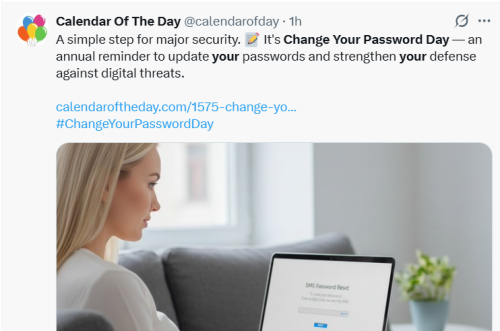
According to Calendar of the day X post, it noted that Change Your Password Day, is an annual reminder to update your passwords and strengthen your defence against digital threats
“A simple step for major security. It’s Change Your Password Day, an annual reminder to update your passwords and strengthen your defence against digital threats,” read the X post.
Once compromised, they rarely affect just one account. Many users reuse the same password across email, mobile money, social media and banking platforms, allowing a single breach to cascade into multiple losses.
Kenya’s rapid digital adoption has amplified both opportunity and risk. Mobile banking, online payments and digital lending have expanded financial inclusion, but they have also created attractive targets for cybercriminals.
Fraudulent emails, phishing links disguised as official alerts, fake login pages and malicious apps shared on social media are now common.
When attackers gain access, victims may lose savings, have loans fraudulently taken in their names, or see personal data misused. Restoring accounts and repairing financial damage can take months, with outcomes that are not always fully resolved.
Building stronger digital defences
Improving password security does not require advanced technical expertise. The foundation is strength and unpredictability. Strong passwords use a combination of uppercase and lowercase letters, numbers and symbols, and are at least 12 characters long. Obvious choices such as names, dates of birth, phone numbers or common words significantly weaken security and are often the first targets of automated attacks.
Equally important is uniqueness. Each account should have a different password. Reusing one password across multiple services effectively links their security, meaning a breach in one platform compromises others.
While this may appear difficult to manage, password managers offer a practical solution. These tools generate and store strong, unique passwords for each service and require users to remember only one master password. Many are freely available and compatible with both mobile devices and computers.
Additional layers of protection further reduce risk. Two-factor authentication, which requires a second verification step such as a one-time code sent to a phone or generated by an app, has become standard for many critical services.
Even if a password is exposed, this extra step can prevent unauthorised access. Activating two-factor authentication takes only a short time but significantly enhances account security.
Rethinking password changes and future solutions
There is growing debate among security experts about how often passwords should be changed.
Frequent mandatory changes can encourage weaker, more predictable choices, undermining their purpose. Current best practice suggests that strong, unique passwords can remain effective for long periods if there is no indication of compromise and if additional protections, such as two-factor authentication, are enabled.
In this context, Change Your Password Day serves less as a call for routine rotation and more as an opportunity to review habits, identify reused or weak passwords, and secure the most sensitive accounts first.
Looking ahead, emerging technologies may eventually reduce reliance on traditional passwords. Passkeys, which use device-based authentication rather than typed credentials, are being introduced by major technology companies.
These systems are resistant to phishing and cannot be stolen in the same way as passwords. However, widespread adoption will take time, and passwords remain the primary gatekeeper for most services.
Change Your Password Day may not command national attention, but its relevance continues to grow. As personal data becomes increasingly valuable, small actions taken today can prevent significant harm in the future.
Reviewing passwords, enabling available security features and adopting tools that support good digital hygiene are practical steps that offer meaningful protection. In a connected society, this modest habit remains one of the simplest ways to reduce exposure to cyber threats.