Willis Otieno warns against inherited political loyalty
By Faith Lagat, January 25, 2026Lawyer and political figure Willis Evans Otieno has cautioned Kenyans against entrenched political dynasties, arguing that inherited loyalty to leaders perpetuates poverty and stifles accountability.
The Safina Party member shared his observations through a series of posts on X dated January 25, 2026, urging communities to prioritise performance over identity in evaluating leadership.
Otieno described the mechanisms used by legacy politicians to maintain control over communities. “Worst of all, they teach people to fear change. Any challenge to them is branded betrayal, disrespect, or an attack on the community itself. The politician becomes the community; to question him is to question your identity,” he stated.
He linked this dynamic to generational economic stagnation, noting, “That is how poverty is inherited, politically, not naturally.”
Shifting focus to results
The lawyer called for a fundamental change in how communities assess leaders, advocating for outcome-based evaluations rather than loyalty tied to family, age, or personal narratives.
“Real liberation begins when communities stop asking who is ours and start asking what works. When leadership is measured not by age, struggle stories, or surnames, but by outcomes. Until then, legacy politicians will continue to grow rich off communities that remain poor,” Otieno emphasised.
Willis Otieno said some politicians deliberately keep communities in poverty to maintain control. He explained that prosperity encourages independence, which in turn prompts people to question leadership.
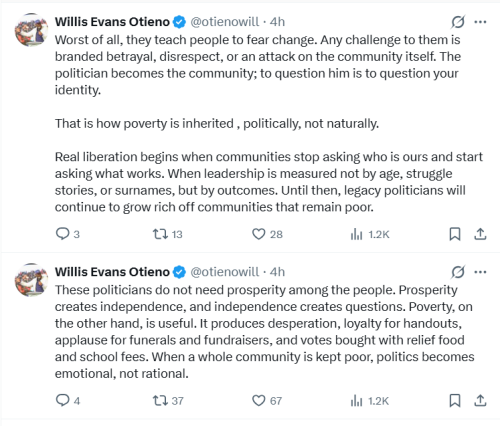
According to Otieno, poverty creates desperation, fosters loyalty through handouts, and generates visible support at funerals and fundraisers. It also makes it easier to influence votes with relief food and school fees.
He added that when entire communities are kept poor, political choices tend to be driven by emotion rather than rational judgment.
“These politicians do not need prosperity among the people. Prosperity creates independence, and independence creates questions. Poverty, on the other hand, is useful. It produces desperation, loyalty for handouts, applause for funerals and fundraisers, and votes bought with relief food and school fees. When a whole community is kept poor, politics becomes emotional, not rational,” he explained.
Otieno’s posts drew attention to concerns about neopatrimonial politics in Kenya and the persistence of identity-based voting.
He positioned his critique as a call for citizens to focus on measurable development outcomes rather than tribal, familial, or historical affiliations when making electoral choices.