Willis Otieno slams tribal politics, demands merit-based leadership ahead of 2027
By Mustafa Juma, April 20, 2026Renowned constitutional lawyer Willis Otieno has issued a sharp rebuke of tribal politics in Kenya, calling for a decisive shift toward competence, integrity, and accountability as the country edges closer to the 2027 general election.
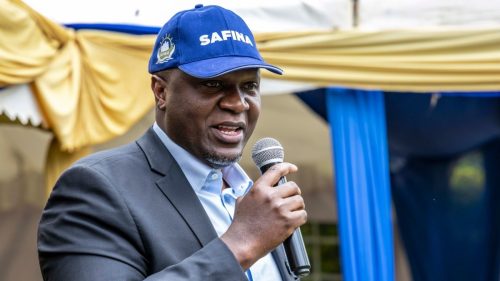
Taking to his official X account in the wee hours of Monday, April 20, 2026, the Safina deputy party leader warned that reducing leadership choices to ethnic considerations risks undermining governance and weakening public institutions.
Otieno emphasised that leadership selection should never be reduced to ethnic identity, arguing that such an approach erodes the very foundations of democracy.
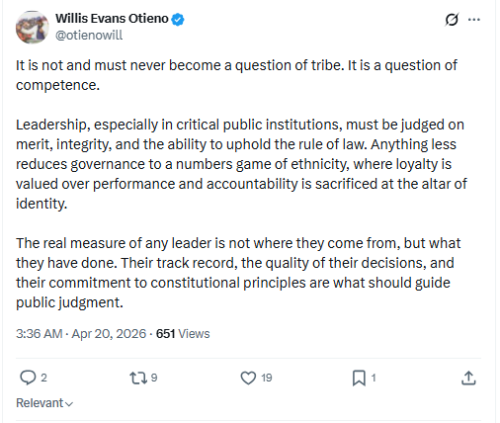
“It is not and must never become a question of tribe. It is a question of competence,” he stated.x
Loyalty vs performance
According to the lawyer, elevating tribe over merit transforms governance into a “numbers game of ethnicity”, where loyalty is prioritised at the expense of performance and accountability.
“Leadership, especially in critical public institutions, must be judged on merit, integrity, and the ability to uphold the rule of law. Anything less reduces governance to a numbers game of ethnicity, where loyalty is valued over performance and accountability is sacrificed at the altar of identity,” he wrote on X.
Otieno further stressed that leaders, especially those entrusted with critical public institutions, must be judged based on their track record, the quality of their decisions, and their commitment to the rule of law and constitutional principles.
He argued that anything less would compromise service delivery and weaken public trust in leadership.
“The real measure of any leader is not where they come from, but what they have done. Their track record, the quality of their decisions, and their commitment to constitutional principles are what should guide public judgment,” Otieno stated.
2027 polls
With political alignments already taking shape ahead of the 2027 elections, Willis Otieno cautioned against a return to divisive identity politics.
His remarks appear to tap into a broader national concern that election cycles in Kenya have historically been influenced by ethnic mobilisation, often overshadowing policy debates.
His remarks add to growing calls from civil society for a more issue-based political discourse, centred on governance, economic management, and institutional reforms.
As Kenya approaches another high-stakes election cycle, the tension between identity politics and merit-based leadership is expected to remain a central theme.
Opposition politics
Saboti Member of Parliament Caleb Amisi has in the past criticised former Deputy President Rigathi Gachagua, warning that what he describes as tribal-driven politics could weaken the opposition and deepen divisions in the country.
In a statement posted on X on Thursday, January 8, 2025, Amisi questioned Gachagua’s political direction and accused him of actions and remarks that, in his view, risk undoing efforts to build a broad national movement against President William Ruto’s administration.