Willis Otieno points out consequences of aggressive borrowing by govt in local banks
By Cynthia Lodite, June 14, 2026City lawyer Willis Otieno has attributed Kenya’s persistent economic challenges to the government’s aggressive domestic borrowing from local banks, which he says crowds out private sector credit and stifles growth.
In a statement on his official X account on Sunday, June 14, 2026, Otieno highlighted some of the consequences of the government’s constant reliance on liquidity from the domestic economy.
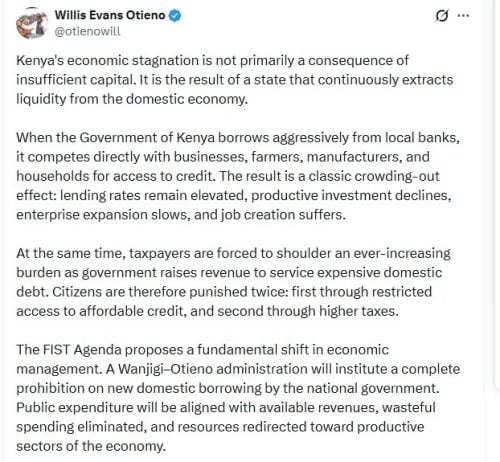
“Kenya’s economic stagnation is not primarily a consequence of insufficient capital. It is the result of a state that continuously extracts liquidity from the domestic economy,” Otieno stated.
On his part, Otieno highlighted a double burden on taxpayers, who face both restricted access to affordable credit and higher taxes to service the growing domestic debt.
Major effects on the citizens
At the same time, the renowned lawyer explained how borrowing from local banks directly affects businesses, farmers, manufacturers, and households in accessing credit.
In his defence, the lawyer maintained that such practices result in lending rates remaining elevated.
In addition, according to Otieno, the government’s move affects productive investment, slows enterprise expansion, and hurts job creation.
“When the Government of Kenya borrows aggressively from local banks, it competes directly with businesses, farmers, manufacturers, and households for access to credit. The result is a classic crowding-out effect: lending rates remain elevated, productive investment declines, enterprise expansion slows, and job creation suffers,” he explained.
At the same time, the lawyer argued that taxpayers are forced to shoulder an ever-increasing burden as the government raises revenue to service expensive domestic debt.
Hence, citizens are punished twice: first through restricted access to affordable credit and second through higher taxes.
The comments come amid ongoing national debates on Kenya’s public debt management, with the opposition party advocating for fiscal discipline, rejection of certain “odious” debts, and a shift toward citizen- and enterprise-driven growth.
“By ending government competition with citizens for credit, interest rates will decline, private sector borrowing will expand, investment will increase, and economic growth will once again be driven by Kenyan enterprise rather than debt accumulation,” he added.