Advertisement
Willis Otieno: If rights were violated, why did impeachment stand?
Tuesday 09th June, 2026 08:43 AM|

Lawyer Willis Otieno may have asked what is becoming the biggest question emerging from the High Court ruling on former Deputy President Rigathi Gachagua’s impeachment: if the court found that constitutional rights were violated, why was the impeachment allowed to stand?
In a statement shared on her X account on Tuesday, June 9, 2026, that question has now shifted public attention from whether Gachagua won or lost the case to whether the Constitution itself was consistently applied.
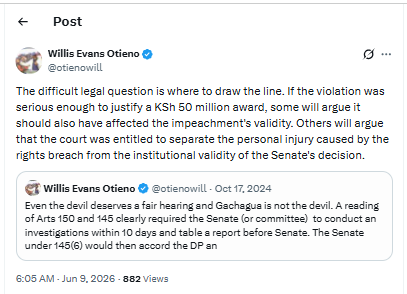
“The difficult legal question is where to draw the line. If the violation was serious enough to justify a Ksh50 million award, some will argue it should also have affected the impeachment’s validity. Others will argue that the court was entitled to separate the personal injury caused by the rights breach from the institutional validity of the Senate’s decision,” he said.
The judges upheld the Senate’s decision to impeach him while simultaneously finding that his right to a fair hearing had been violated after senators declined his request for an adjournment on medical grounds. They then awarded him Ksh50 million in constitutional damages.
You Might Also Like



The ruling has left legal experts sharply divided and opened a fresh constitutional debate on where courts should draw the line between individual rights and institutional decisions.
The Ksh50 million question
Lawyer Willis Otieno captured the issue in a simple but powerful question: if rights were violated, why did the impeachment survive?
The difficult legal question is where to draw the line. If the violation was serious enough to justify a Ksh50 million award, some will argue it should also have affected the impeachment’s validity. Others will argue that the court was entitled to separate the personal injury caused by the rights breach from the institutional validity of the Senate’s decision.
But can constitutional violations and constitutional outcomes truly be separated?
The Constitution was butchered
Lawyer Evans Ndong’ has gone further, strongly criticising the ruling and accusing the court of creating a dangerous constitutional precedent.
“We may not like Rigathi Gachagua, but we cannot butcher the Constitution in the manner the three-judge bench did,” he argued.
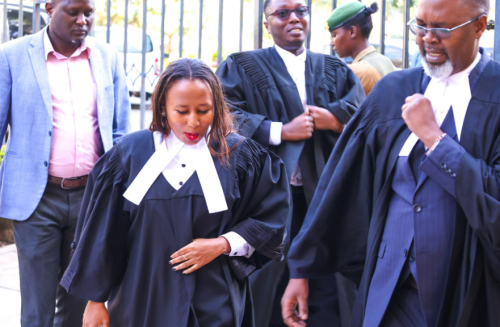
According to Ndong’, once a court finds that the right to a fair hearing under Article 50 has been violated, the legal consequence should be straightforward: the affected process should be nullified.
He insists that the right to a fair hearing is not an ordinary constitutional protection but a foundational right that cannot be compromised regardless of circumstances.
The battle may not be over
Even legal experts supporting the balancing approach admit that the ruling has left unresolved questions.
Questions surrounding Article 99(3), future political implications and constitutional remedies remain largely unanswered.
One thing is becoming increasingly clear: the Gachagua ruling may have ended an impeachment case, but it may have started a much larger constitutional fight. The Court of Appeal could ultimately decide whether rights can be violated, compensated and yet leave the final political outcome untouched.
Author
Latest News






Advertisement
More on Inside Politics