Why IEBC is facing dilemma over degree requirement for MP, MCA aspirants
By Aloys Michael, May 25, 2026With barely 14 months remaining before Kenya heads to the 2027 General Election, the debate over academic qualifications for political aspirants has once again returned to the centre of the country’s electoral discourse.
The Independent Electoral and Boundaries Commission (IEBC) is now facing a fresh dilemma over whether to enforce the university degree requirement for those seeking parliamentary and county assembly seats.
For years, the electoral agency has struggled to implement the controversial provision due to political resistance, legal challenges and constitutional hurdles. The uncertainty now threatens to create confusion among aspirants preparing for the next polls, especially those eyeing seats in the National Assembly, Senate and county assemblies.
Although the law introducing degree requirements was first enacted in 2011, Parliament repeatedly postponed its implementation, with lawmakers arguing that many potential candidates needed more time to acquire academic qualifications.

The issue has remained politically sensitive, with critics maintaining that leadership should not be reserved for the elite or the highly educated.
Currently, only candidates seeking the Presidency, Deputy Presidency and gubernatorial seats are required by law to possess university degrees.
However, attempts to extend the same threshold to Members of Parliament (MPs ) and Members of the County Assembly (MCAs) have repeatedly hit a brick wall.
In April 2022, the High Court dealt a major blow to the requirement after declaring Section 22 of the Elections Act unconstitutional. Justice Anthony Mrima ruled that the provision had been enacted without meaningful public participation, making it inconsistent with constitutional principles under Article 10.
“I find and hold that there was no meaningful public participation towards the enactment of Section 22(1)(b)(ii) of the Elections Act. In sum, the impugned provision falls short of the constitutional requirement under Article 10(2)(a) of the Constitution,” Justice Mrima ruled in a virtual judgment.
The ruling effectively opened the door for aspirants without degrees to contest in the 2022 elections, dealing a significant setback to the IEBC’s efforts to professionalise elective leadership through academic thresholds.
Before the court decision, the commission under the late former chairman Wafula Chebukati had insisted that parliamentary aspirants would be required to present valid university degrees from recognised institutions before clearance.
The directive immediately sparked outrage among politicians, particularly senators, who accused the electoral body of attempting to lock out ordinary Kenyans from leadership.
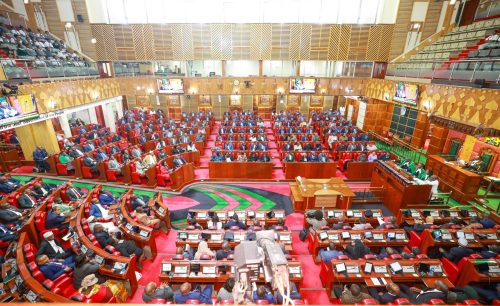
The backlash prompted Parliament to pass the Elections (Amendment) Bill, 2021, which removed the degree requirement for MPs and MCAs.
The Bill, sponsored by former Elgeyo Marakwet Senator Kipchumba Murkomen, received overwhelming support in the Senate, with 27 senators voting in favour.
Must not must?
Legislators argued that leadership should be determined by the will of voters rather than academic papers. Some lawmakers further claimed that the requirement discriminated against capable leaders from marginalised and rural communities who may not have had access to higher education opportunities.
Despite the legal and political setbacks, the IEBC appears determined to revisit the issue ahead of the 2027 elections. However, the commission remains cautious about reigniting another legal battle too early.
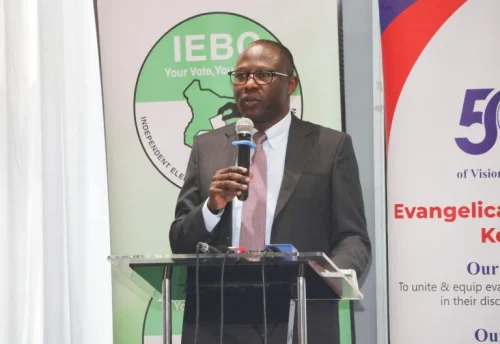
IEBC chairman Erastus Ethekon recently indicated that the commission was taking its time before reintroducing the matter for public debate and possible legislative action.
“We are not in a hurry because if we do it now, someone will again try to frustrate the process, but we will do it at the appropriate time,” Ethekon said.
It remains unclear whether the current IEBC leadership has already begun conducting fresh public participation aimed at curing the legal defects identified by the High Court.
Unless the process is undertaken properly and transparently, any attempt to reintroduce the requirement could once again collapse in court.
Even as the degree debate lingers, the electoral agency has unveiled several fresh reform proposals intended to strengthen the credibility and management of the 2027 General Election.
Among the proposals currently before Parliament’s Justice and Legal Affairs Committee is a new rule requiring any person nominated to a county assembly to be a registered voter within the same county. If adopted, the proposal would prevent individuals from seeking nomination positions outside their counties of voter registration.
The commission is also seeking prosecutorial powers over election-related offences through the repeal of Section 20 of the Electoral Code of Conduct. The proposed changes would empower the IEBC to directly handle cases involving electoral malpractices, including fake academic certificates submitted by aspirants.
Additionally, the IEBC wants the maximum number of voters per polling station increased from 700 to 800, arguing that improved technology and additional election clerks would help ease congestion and accelerate voting.