Why Gachagua is calling for a new workers’ movement to rival COTU
By Aloys Michael, May 6, 2026A fresh political fault line is emerging in Kenya’s labour movement after former Deputy President Rigathi Gachagua called for the formation of a new workers’ organisation to rival the long-established Central Organisation of Trade Unions (COTU), accusing it of failing to defend employees against what he termed punitive government policies.
Speaking during the launch of the Kenya Labour Market and Worker Welfare Report 2026 on Tuesday, May 5, 2026, the Democracy for Citizens Party (DCP) leader mounted a sustained critique of William Ruto’s economic management, arguing that ordinary workers are bearing the brunt of a slowing economy and rising statutory deductions.
Gachagua framed his remarks around deteriorating economic indicators, claiming Kenya’s growth has fallen sharply in recent years.
“Our economy has dipped from 7.6 per cent growth in 2021 to the current 4.6 per cent. Numbers do not lie,” he said, positioning the decline as evidence of weakening economic stewardship.
He further claimed that state officials risk reprisals for releasing data that contradicts the administration’s narrative, suggesting a growing tension within government institutions over transparency.

Salary bane
Key in his critique was the Kenyan payslip, which he argued has become a symbol of shrinking household income. Gachagua cited statutory deductions such as Pay As You Earn (PAYE), the Social Health Authority (SHA), the National Social Security Fund (NSSF), and the controversial housing levy as key contributors to reduced take-home pay.
According to him, these deductions now consume between 30 and 40 per cent of workers’ wages, leaving many struggling to meet daily expenses.
“There was a time when a payslip meant dignity in Kenya. Now it reflects strain,” he said, tapping into broader public discontent over the rising cost of living.
The DCP boss, singled out the housing levy as particularly contentious, describing it as avoidable and calling for greater accountability in how the funds are managed.
The remarks come amid ongoing debate over Kenya’s fiscal strategy, with the government defending increased deductions as necessary to fund social programmes and reduce reliance on debt.
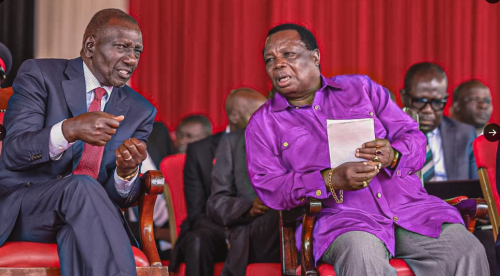
The payslip politics
However, Gachagua argues that the measures have been implemented at a time when wages have largely stagnated, amplifying the burden on workers.
Gachagua also took direct aim at Francis Atwoli, Secretary General of COTU, accusing him of aligning too closely with the government at the expense of workers’ interests, adding that the union leadership has abandoned its watchdog role, characterising it as compromised and ineffective.
“We have a labour union led by a professional broker,” Gachagua said.
His comments reflect a wider push by opposition figures to reposition themselves as champions of the working class ahead of the 2027 general election.
The proposal to establish an alternative labour organisation signals a potentially significant shift in Kenya’s industrial relations landscape.

COTU has historically been the dominant voice for workers, and any credible rival could reshape collective bargaining dynamics and political alliances within the labour sector. Gachagua acknowledged that such a move could face resistance from regulatory authorities, including the Registrar of Trade Unions, but insisted that workers deserve a choice in representation.
His call was echoed by other speakers at the event. Former Private Security Regulatory Authority (PSRA) Director General Fazul Mohamed warned that rising deductions without corresponding salary increases have turned the payslip into “a source of depression rather than happiness.”
He argued that the working class will play an important role in the 2027 elections, reinforcing the growing politicisation of labour issues.
Meanwhile, Okala urged the government to revisit its minimum wage policies, saying recent increments have failed to keep pace with inflation and the high cost of living.
As economic pressures persist, Gachagua’s push for a new workers’ movement highlights an emerging convergence between labour grievances and political mobilisation.
With about 15 months to the 2027 election cycle already taking shape, the battle over the Kenyan payslip is increasingly becoming a central campaign issue, one that could redefine both the country’s labour movement and its political landscape.