Starehe MP Mwago: Ruto defending himself by calling MPs corrupt is ironic
By Kiprono Keileb, August 20, 2025Starehe Member of Parliament Amos Mwago has criticised President William Ruto’s recent defence of the controversial Finance Bill 2024, describing it as both ironic.
In a statement on his official X account posted on Wednesday, August 20, 2025, Mwago said he was glad to have abstained from voting for the punitive bill, which has sparked public debate and allegations of executive overreach.
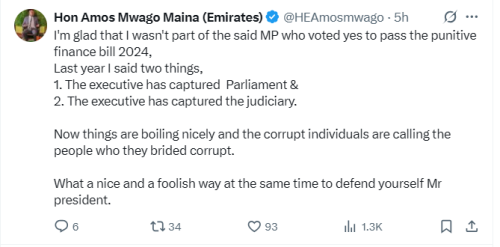
“I’m glad that I wasn’t part of the said MP who voted yes to pass the punitive finance bill 2024,” Mwago said.
The legislator reiterated concerns he first raised last year, warning of the growing influence of the Executive over key state institutions. He cautioned that such dominance risks undermining the principles of separation of powers and weakening institutional independence, which are critical for safeguarding democracy and accountability.
“Last year I said two things: 1. The executive has captured Parliament & 2. The executive has captured the judiciary,” Mwago noted.
According to the Starehe MP, the current backlash against critics of the bill exposes the paradox in the President’s approach. Mwago pointed out that some officials, whom he described as corrupt, are now branding those they allegedly bribed as corrupt themselves, a move he termed both “nice and foolish.”
“Now things are boiling nicely, and the corrupt individuals are calling the people corrupt. What a nice and foolish way at the same time to defend yourself, President,” Mwago said.
Mwago’s remarks come amid a broader debate on the independence of Parliament and the judiciary, with critics arguing that the executive’s influence undermines the constitutional separation of powers.
The MP’s statement is likely to intensify scrutiny on the Finance Bill 2024 and the role of executive authority in shaping legislative outcomes. By highlighting the irony of the President’s defence, Mwago emphasises the need for accountability and integrity in the management of public affairs.
As the public and political analysts dissect the implications of the bill, Mwago’s comments add to a growing chorus of voices questioning the balance of power between Kenya’s legislative and executive arms. His forthright critique underscores the continuing tensions within the government over governance, oversight, and the rule of law.