Senator Thang’wa calls for rejection or major amendments to Finance Bill 2026 over job loss fears
By Kenneth Mwenda, June 18, 2026Kiambu Senator Karungo wa Thang’wa has called on Members of Parliament to either reject or significantly amend the Finance Bill 2026, warning that it could cost thousands of jobs and weaken Kenya’s local manufacturing sector.
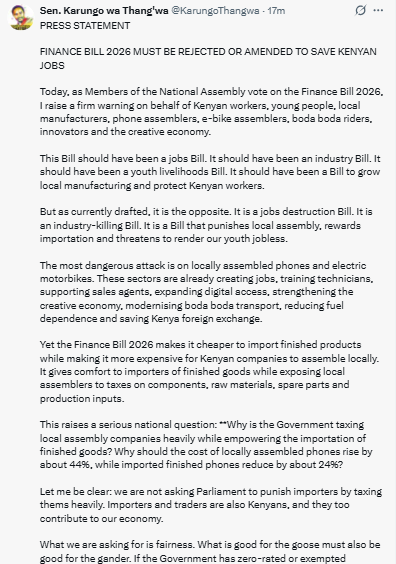
Speaking in a press statement shared on Thursday, 18 June 2026, on his official X account, the senator said the bill, as currently drafted, undermines efforts to grow local industries, especially in mobile phone assembly and electric mobility.
“This bill should have been a jobs bill. It should have been an industrial bill. It should have been a youth livelihoods bill,” Thang’wa stated. “But as currently drafted, it is a job-destroyer bill.”
Concerns over local manufacturing and jobs
The senator said the Finance Bill 2026 unfairly targets local manufacturers while making imported finished goods cheaper. He warned that this imbalance could destroy Kenya’s growing assembly sector, which includes mobile phones and electric motorbikes.
These industries have created employment opportunities for young people, including technicians, sales agents, and factory workers. They have also supported boda boda riders who are shifting to electric motorbikes to reduce fuel costs.
Thang’wa argued that the Bill increases taxes on components, raw materials, spare parts, and production inputs used by local assemblers. At the same time, he said, imported finished products are becoming cheaper due to favourable tax treatment.
He raised concern over what he called a policy reversal, saying local firms may now struggle to compete with imported goods.
“Why should the cost of locally assembled phones rise by about 44%, while imported finished phones reduce by about 24%?” he asked.
The senator said the policy risks reversing progress made in local manufacturing, particularly in value addition and industrialisation.
Thang’wa clarified that he does not oppose importers or traders. He said they also contribute to the economy and should not be punished.
“Importers and traders are also Kenyans, and they too contribute to our economy,” he said.
However, he insisted that fairness must guide tax policy. He called on the government to ensure that local manufacturers receive the same tax treatment as imported finished goods.
“If the Government has zero-rated or exempted finished imported products, then the same treatment must apply to the components, raw materials, spare parts and production inputs used by local assemblers,” he said.
He warned that without equal treatment, local factories would shut down, investors would withdraw, and job losses would increase.
Wider debate on Finance Bill 2026
The Finance Bill 2026 has triggered sharp debate in Parliament. The government says the bill aims to modernise the tax system, improve compliance, and expand the tax base without overburdening citizens.
Majority Leader Kimani Ichung’wah has defended the bill, saying it does not introduce harmful new taxes. Finance Committee Chairperson Kuria Kimani has also argued that the proposals are based on public participation and seek to improve efficiency rather than increase tax rates.
According to parliamentary records, the Finance Committee received more than 100,000 submissions during public participation across 13 counties. Opposition MPs continue to raise concerns. They argue that the bill introduces hidden taxes through technical changes in tax law.
Kathiani MP Robert Mbui described the bill as punitive, saying it places a burden on ordinary Kenyans.
“I rise to oppose this draconian, punitive, knee-on-the-neck-of-Kenyans Finance Bill 2026,” Mbui said during debate in the National Assembly.
Other MPs warned that changes affecting second-hand clothes (mitumba), rental income, and tax administration could increase the cost of living.
Some lawmakers also linked the debate to the 2024 anti-tax protests, warning that public anger could return if concerns are not addressed.
The Finance Bill 2026 debate comes at a time of economic pressure and rising youth unemployment. Kenya continues to promote industrialisation and local manufacturing as key drivers of job creation.
Thang’wa warned that the bill could undermine this goal if passed without changes. He said Kenya cannot achieve industrial growth while taxing local production more heavily than imports.
“A country cannot import its way into industrialisation,” he said. “A country cannot tax its factories to death and still claim to be creating jobs.”