Salasya questions Ruto’s agricultural wage rise as sugar farmers face falling cane prices
By Mustafa Juma, May 1, 2026Mumias East Member of Parliament (MP) Peter Salasya has raised concerns over the government’s commitment to increasing agricultural wages, arguing that recent developments in the sugar sector point to deep structural contradictions in policy.
His remarks come in the wake of President William Ruto’s Labour Day announcement of a 12 per cent increase in general wages and a 15 per cent increase in agricultural wages for Kenyan workers.
Concerns over sugar sector pricing
Taking to his official X account on Friday, May 1, 2026, Salasya pointed to declining sugarcane prices as a major concern for farmers, warning that the economic realities on the ground may undermine the effectiveness of any wage adjustments in the agricultural sector.
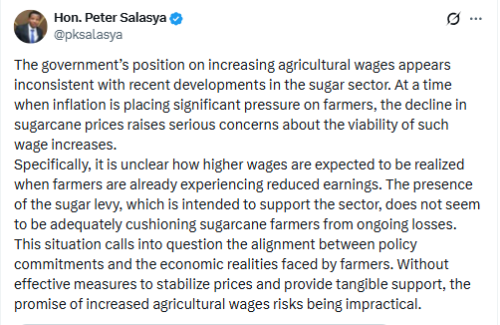
“The government’s position on increasing agricultural wages appears inconsistent with recent developments in the sugar sector,” Salasya stated.
“At a time when inflation is placing significant pressure on farmers, the decline in sugarcane prices raises serious concerns about the viability of such wage increases.”
Questions over sugar levy impact
The MP also questioned the effectiveness of the sugar levy, which is intended to support development and stabilisation within the sector.
“Specifically, it is unclear how higher wages are expected to be realized when farmers are already experiencing reduced earnings,” he said.
“The presence of the sugar levy, which is intended to support the sector, does not seem to be adequately cushioning sugarcane farmers from ongoing losses.”
The sugar levy is collected to fund sector rehabilitation and support services, but critics have repeatedly raised concerns over its impact and transparency in allocation.
Salasya argued that the situation highlights a broader disconnect between government policy announcements and the lived realities of farmers, particularly in key agricultural zones such as Western Kenya.
“This situation calls into question the alignment between policy commitments and the economic realities faced by farmers,” he said.
“Without effective measures to stabilize prices and provide tangible support, the promise of increased agricultural wages risks being impractical.”
Sugar cane prices
Salasya’s remarks come days after the Kenya Sugar Board announced a downward revision of sugarcane prices, cutting the rate from Ksh5,750 to Ksh5,500 per tonne.
In a notice issued on Saturday, April 25, 2026, following meetings of the Interim Sugarcane Pricing Committee held on April 17 and April 24, 2026, the board confirmed that the new minimum price of Ksh5,500 per tonne takes immediate effect.
The directive, signed by Acting CEO Jude Chesire, instructs all millers to comply with the revised rate and ensure timely payments to farmers.
“The 4th Interim Sugarcane Pricing Committee was appointed by the Cabinet Secretary, Ministry of Agriculture and Livestock Development vide his letter Ref: MOALF/S.11/25a/7/TY/3 dated 9th January 2025,” the notice reads in part.
“We refer to the Fifth and Fourth meetings of the interim sugarcane pricing committee held virtually on 24th April 2026 and physically on 17th April 2026. respectively, and subsequent extensive consultations on Sugarcane Prices. This is therefore to notify you that a new sugarcane price of Ksh. 5,500 per tonne has been approved effective immediately.”
The decision effectively reverses a previously higher price point of Ksh5,750 per tonne, raising concerns over policy inconsistency and the financial impact on cane growers who had anticipated improved earnings amid rising production costs.
However, the board argues that the new set price is still high as compared to the neighbouring countries in the region.
“This new price is comparatively high in the region. You are hereby requested to adhere to the new minimum cane price while making payments to the farmers on time,” the board stated.