Salasya blasts delay in sugar reforms, warns of industry collapse risk
By Ndiritu Wanjiru, April 28, 2026Mumias East legislator Peter Salasya has called for attention to what he describes as a growing disconnect between the legislative and executive processes, saying that the failure to fully implement critical reforms in the sugar industry is affecting farmers and the industry’s revival.
In his comments on his X handle on Tuesday, April 28, 2026, on the sugar industry, Salasya has said that while Parliament has been responsive to the needs of the sector by passing progressive legislation, such as the Sugar Act, the executive has been lagging in fully operationalising the act, creating reforms and uncertainty in the sector.
“The observed gap between legislative action and executive implementation raises serious governance concerns. While the National Assembly fulfils its mandate by debating and passing laws intended to benefit citizens, the effectiveness of these laws ultimately depends on timely and faithful execution by the executive,” Salasya said.
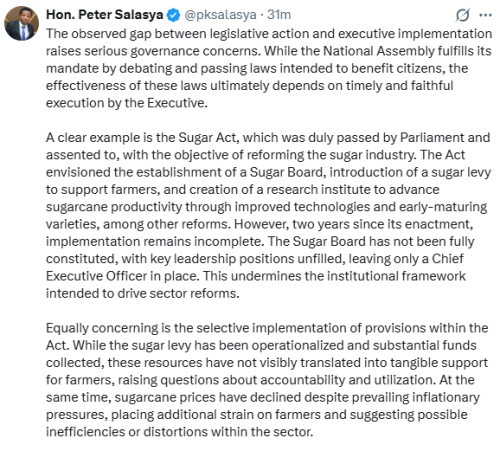
The lawmaker further indicated that the Sugar Act was meant to revolutionise the sector by establishing a functioning sugar board, introducing a sugar levy to assist farmers and establishing a sugar research institute to boost productivity levels and encourage the cultivation of new sugarcane varieties. But he noted that key provisions of the act are yet to be fully operationalised, with key positions in the Sugar Board still unoccupied.
“The Act envisioned the establishment of a Sugar Board, introduction of a sugar levy to support farmers, and creation of a research institute to advance sugarcane productivity through improved technologies and early-maturing varieties, among other reforms,” he added.
The legislator claimed that this has not only damaged the institutional coordination in the sector but also denied farmers the maximum benefits of the intended reforms.
Salasya also raised concerns about what he alleged to be a piecemeal approach to implementing the legislation, saying that while the sugar levy has been collected, farmers have not received corresponding benefits. This, he noted, casts doubt on the accountability and transparency of resource use in the industry.
Reasons for low sugarcane prices
The first-time MP decried the persistent drop in sugarcane prices despite increasing costs of production and general inflation, saying that this is exacerbating the financial challenges faced by farmers in sugar-growing areas.

The MP also pointed to the continued challenges faced by sugar factories in the country, which, he said, is often cited as a reason to lower cane prices. He stressed that these difficulties are taking place at a time of growing sugar imports, which he said is inconsistent and potentially destructive for local sugar growers.
Salasya urged quick steps to ensure policy reforms are in line with the intent of the law, emphasising that if this is not done, it could undermine the livelihoods of farmers and the sustainability of the sugar sector.
He called on government departments to prioritise the implementation of the Sugar Act to ensure that reforms benefit farmers and the economy.