Safina Party unveils agenda to ease Kenya’s debt burden
By Ndiritu Wanjiru, June 8, 2026Safina Party has stepped up its campaign for its FIST Agenda, calling it a movement for the people for addressing the escalating public debt in Kenya and expanding access to basic social services.
Taking it to his social X handle on Monday, June 8, 2026, Willis Otieno, a constitutional lawyer and the Safina Party deputy party leader, has said that the FIST agenda is no longer just a political platform or a policy paper or even a closed-door agenda. Rather, he said, it has turned into a national discourse, as average Kenyans demand clarity on the nation’s debt commitments.
“The FIST agenda is no longer confined to meeting rooms, policy papers, or political platforms; it is now firmly in the hands of the people,” Willis stated.
“Across the country, Kenyans are asking the same question: how can citizens continue paying for debts whose benefits they cannot see in their schools, hospitals, roads, industries, or livelihoods?” he added.
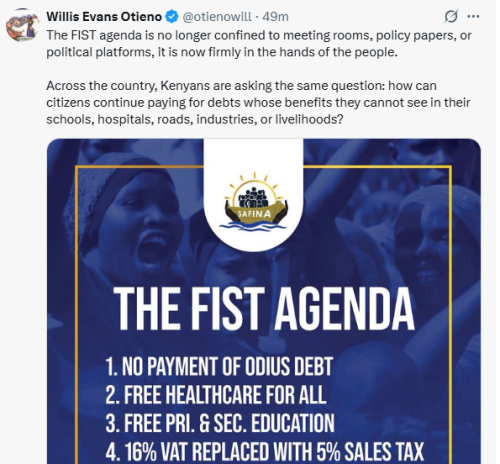
Willis has noted that the FIST agenda aimed at changing the economic drivers of Kenya. One of its tenets is the rejection of “odious debt” loans supposedly taken out without adequate transparency, accountability and public involvement.
The agenda also calls for free medical services for all Kenyans and access to primary and secondary education, which should be funded by the state and not the beneficiaries themselves.
Besides, Safina recommends that the existing 16 per cent Value Added Tax (VAT) be substituted by a five per cent sales tax. The party says such a measure would help alleviate the burden of living, lower the tax burden on consumers and boost economic activity.
Safina Party’s plan
One of the other large plans in the FIST agenda is to stop the national government from borrowing at home. Those in favour of the policy argue that over-borrowing by the government reduces access to cheap credit for private sector enterprises and discourages the development of the private sector.
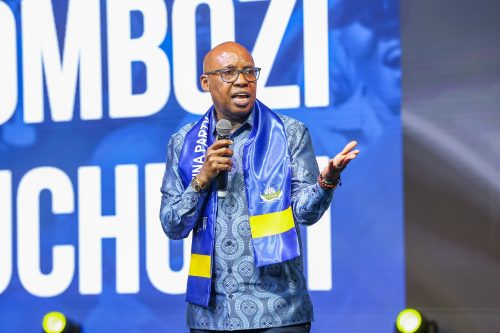
The growing public acceptance of the FIST Agenda signals a general public appetite for accountability in public finance management, Otieno said. He pointed out that Kenyans are increasingly worried about the indebtedness process of borrowing, spending and repayment of public debt, especially with the high living costs and economic challenges.
The Safina Party feels that the FIST agenda is an alternative economic model based on transparency, social upliftment, and fiscal responsibility, which addresses the debt sustainability concerns in Kenya.
The FIST Agenda has become one of the policy frameworks that is gaining traction to redefine the relationship between public borrowing, taxation and service delivery in Kenya.