Omanyo: Ksh12B claim will form part of ODM-UDA negotiations
By Kenneth Mwenda, May 7, 2026Acting Orange Democratic Movement (ODM) Secretary General Catherine Omanyo has said the party’s demand for Ksh12 billion in unpaid political party funding will form part of any negotiations with the government, insisting the money cannot be released without legal budget approval.
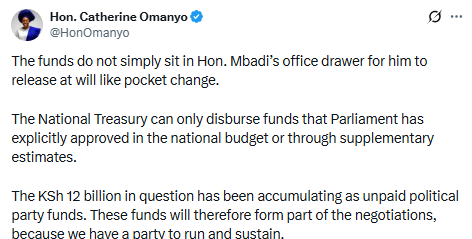
In a statement posted on X on Thursday, May 7, 2026, Omanyo defended Treasury Cabinet Secretary John Mbadi amid growing pressure from sections of ODM leaders demanding the immediate release of the funds.
“The funds do not simply sit in Hon. Mbadi’s office drawer for him to release at will like pocket change,” Omanyo said.
She explained that the National Treasury can only release money approved by Parliament through the national budget or supplementary estimates.
“The National Treasury can only disburse funds that Parliament has explicitly approved in the national budget or through supplementary estimates,” she added.
Omanyo said the Ksh12 billion being demanded by ODM has built up over several years as unpaid allocations from the Political Parties Fund. According to her, the issue is now part of wider political discussions because the party needs money to sustain its activities.
“These funds will therefore form part of the negotiations, because we have a party to run and sustain,” she said.
Her remarks come at a time when ODM is facing internal disagreements over the long-running legal battle that established the amount owed to the party.
Fresh ODM funding row
Siaya Governor James Orengo recently claimed he personally initiated the court case that led to the determination of the billions owed to ODM by the government.
“The Ksh12 billion figure exists today only because of the ruling in the case I filed,” Orengo said.
He also criticised a section of ODM members allied to the “Linda Ground” faction for demanding the money while attacking him politically.
But ODM has pushed back strongly against Orengo’s claims.
In a statement issued on Tuesday, the party said the decision to file the case was made collectively by its National Executive Committee and not by Orengo alone.
“We have noted the claim by Gov. James Orengo that he personally initiated the matter. With respect, that position is not accurate,” ODM said.
The party maintained that Orengo was later brought on board to offer legal services on a pro bono basis because of his legal experience and seniority within the party.
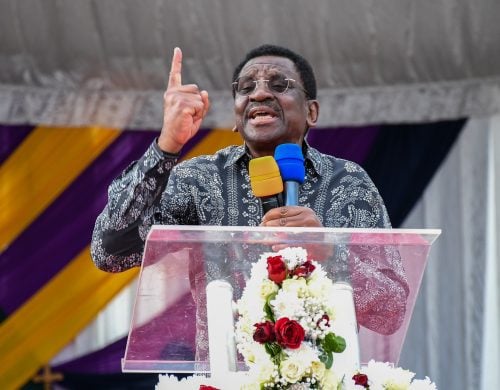
ODM, however, said the arrangement later changed after the introduction of lawyer Julie Soweto and her law firm, which later demanded legal fees after the party won the case in both the High Court in 2016 and the Court of Appeal in 2018.
According to ODM, the party paid Ksh40 million to the firm, but it is now facing another legal claim of more than Ksh350 million over the same matter.
“The demand came as a surprise to everyone,” the party said, adding that the late party leader Raila Odinga had criticised the legal team over the fee demands.
The dispute has exposed fresh divisions within ODM at a time when the party is also discussing its political future ahead of the 2027 General Election.
During a recent retreat in Mombasa, several ODM leaders demanded the immediate settlement of the funds, arguing that the delay has affected the party’s operations across the country.
Deputy party leader Simba Arati had taken a tougher stand, saying ODM would not engage in talks with President William Ruto and the ruling UDA party before the money is paid.
“We will not have any talks with UDA. That cash is what we need to run our party as we move forward,” Arati said during the meeting.
According to Treasury data, only Ksh3.1 billion was allocated to all political parties in the 2024/25 financial year, far below the projected Ksh12.8 billion based on revenue collections. The Office of the Registrar of Political Parties has previously flagged arrears exceeding Ksh15 billion, with ODM’s share estimated at Ksh12 billion.
The Political Parties Act requires at least 0.3 per cent of national revenue to be allocated annually to political parties. ODM argues that despite its large representation in Parliament and county governments, the allocations made over the years have fallen below what the law requires.