NCCK raises concern over money politics ahead of 2027 polls
By Faith Lagat, July 10, 2026The National Council of Churches of Kenya (NCCK) has urged the Independent Electoral and Boundaries Commission (IEBC) to address the growing influence of money in politics ahead of the 2027 General Election, saying elections should be decided by ballots rather than financial inducements.
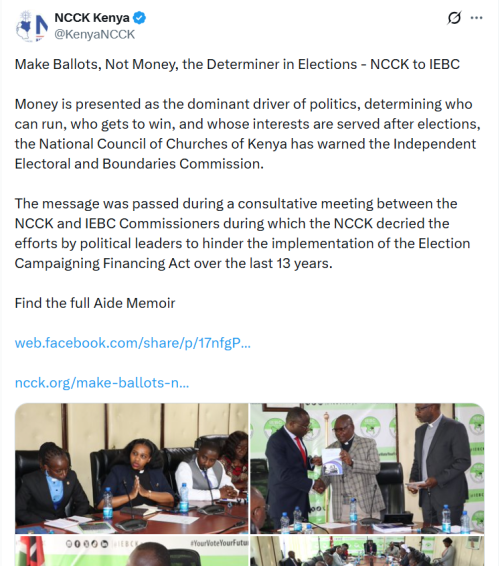
The concerns are contained in an Aide Memoir presented to the IEBC during a consultative meeting held on July 8, 2026. The meeting brought together IEBC Chairperson Erastus Edung Ethekon, commissioners and NCCK leaders, including Rev Elias Otieno Agola and Rev Canon Chris Kinyanjui.
The church leaders commended the commission for engaging stakeholders but reminded it of its constitutional mandate under Article 88 to conduct free, fair and credible elections.
The meeting came as the IEBC prepares to mark its first anniversary and with about 13 months remaining before the August 10, 2027 General Election.
“From the study, we found that the money, religion, coercion and violence are weakening Kenya’s democratic outcomes by distorting citizen choices and public accountability,” read the statement dated July 10, 2026, in part.
Money politics under scrutiny
In the memorandum, the NCCK expressed concern over the increasing role of money in elections, saying the trend threatens the integrity of Kenya’s democratic process.
The council cited findings from its Study on the Influence of Money and Religion on Democratic Outcomes in Kenya, which says financial resources increasingly determine who contests elections, who wins and whose interests are served after the polls.
According to the report, excessive campaign spending has contributed to voter bribery, intimidation, mobilisation of gangs and misuse of public resources during elections.
The NCCK also raised concern about the delayed implementation of the Election Campaign Financing Act, noting that the law has remained inactive for more than a decade.
While welcoming the IEBC’s development of campaign financing regulations and spending limits for the 2027 elections, the council said broader public participation is needed before the regulations are finalised. It pledged to mobilise church members to participate in the exercise.
The memorandum also highlights concerns over voter bribery and economic inducements witnessed during recent by-elections, saying such incidents require firm enforcement of electoral laws.
Calls for reforms
The NCCK further called for measures to address the use of public resources by incumbents during campaigns, political violence, weak public confidence in the electoral process and delays in electoral law reforms.
It also pointed to concerns over political party nominations, saying transparent internal party processes are essential for credible elections.
The council urged the commission to strengthen enforcement mechanisms against electoral offences regardless of the status of those involved and called for closer collaboration with other institutions responsible for election security and accountability.
Ol Kalou by-election concerns
The memorandum comes amid heightened political activity ahead of the July 16 Ol Kalou parliamentary by-election.
The by-election has attracted national attention following concerns raised by political leaders and the IEBC over voter bribery, campaign-related violence and the use of public resources during campaigns.
Earlier this week, IEBC Chairperson Erastus Ethekon warned that the commission could postpone or cancel the by-election if the prevailing environment does not support a free and fair election.
The NCCK said addressing electoral malpractice before the 2027 General Election will be critical in strengthening public confidence in the electoral process.
Besides the memorandum, the council presented the commission with copies of its study, simplified versions of the report, sermon guides and guidelines for engaging political leaders.
The church leaders said they remain committed to supporting peaceful, credible and transparent elections through civic education and public participation.