Muthama rubbishes chaos in churches, says it cannot decide Kenya’s elections
By Kiprono Keileb, January 29, 2026Former Machakos Senator Johnson Muthama has dismissed the notion that disorder in places of worship can influence election outcomes, following a recent incident at Witima ACK Church in Nyeri County.
The disruption, which involved tear gas during a Sunday service attended by former Deputy President Rigathi Gachagua, reignited debates about the intersection of politics, security, and public life in Kenya.

In a statement shared on X on Thursday, January 29, 2026, Muthama reflected on the incident and its wider implications for the country’s democratic journey.
“Does victimhood win elections in Kenya? Moments of political confrontation often become defining chapters in a nation’s democratic journey, not merely because of the disruption itself, but because of how citizens interpret what they witness. The recent attack during a Sunday church service in Witima ACK, Nyeri County, where tear gas disrupted worshippers, and former Deputy President Rigathi Gachagua was present, has once again brought into focus the fragile line between politics, security, and public life in Kenya,” Muthama wrote.
He emphasised that places of worship should remain sanctuaries of peace, warning that chaos can deepen fear and political tension, but does not automatically translate into voter sympathy.
“A church is ordinarily a place of peace, prayer, and unity. When chaos erupts in such a setting, it sends a message that goes far beyond the immediate incident. It creates fear, deepens political tension, and shapes public perception. In a politically charged environment, perception can be as powerful as reality,” he wrote.
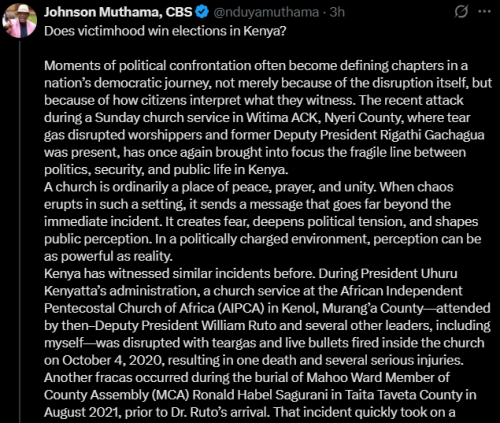
Muthama drew parallels with past disruptions in Kenya, including attacks at a church service in Kenol, Murang’a County, in 2020 and during a burial in Taita Taveta County in 2021, noting the political narratives that often follow such events.
“The first question is unavoidable: Does chaos help someone win an election, whether it is caused by the state or stage-managed by individuals seeking public sympathy? Experience suggests that when a political figure appears to be mistreated, humiliated, or unfairly targeted, public sympathy can shift in their favour. However, it would be a mistake to assume that chaos is a reliable path to victory. Public sympathy is not automatic, and it does not last forever,” Muthama’s statement on X reads.
He warned that repeated reliance on disorder as a political tool risks public scepticism, fatigue, and doubt. Muthama further highlighted concerns over the potential manipulation of such events for political gain.

“This leads to a second, more sensitive question: If repeated incidents are used to generate sympathy, will they produce the same outcome for those involved? The answer is not necessarily. Kenya’s political awareness has grown. Citizens are more critical and more alert to the possibility of political theatre,” he wrote.
Muthama concluded by questioning the origin and responsibility for the violence, calling attention to the security risks posed by unregulated actors and the sources of their weapons.
“Are the goons causing this mayhem, or is the system responsible? If it is the goons who are supplying them with these weapons?” he asked.