Advertisement
Kenya’s coffee and tea sector faces diminishing returns – Justina Wamae
Thursday 02nd October, 2025 09:16 AM|

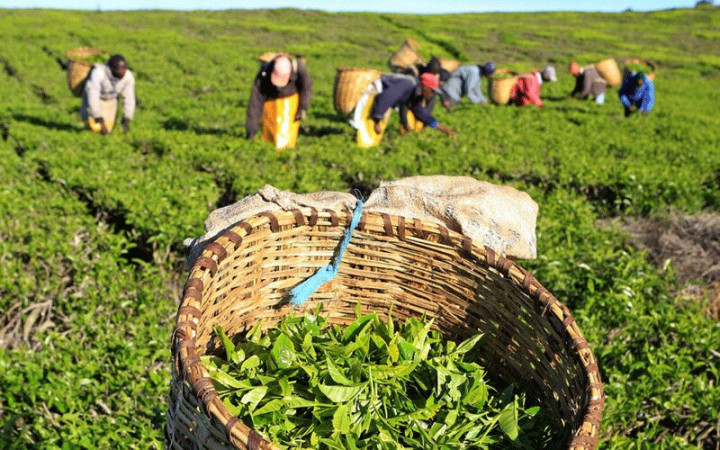
Former Roots Party presidential running mate Justina Wamae has warned that Kenya’s centuries-old coffee and tea industry is now facing diminishing returns, raising concerns about the country’s ability to remain competitive in the global market.
Wamae highlighted the challenges in a statement posted on her official X account on Thursday, October 2, 2025, emphasising that the sector has reached a plateau after 100 years of cultivation.
Also watch: Coffee farmers protest DSS payment system and rising theft at Komothai AGM.
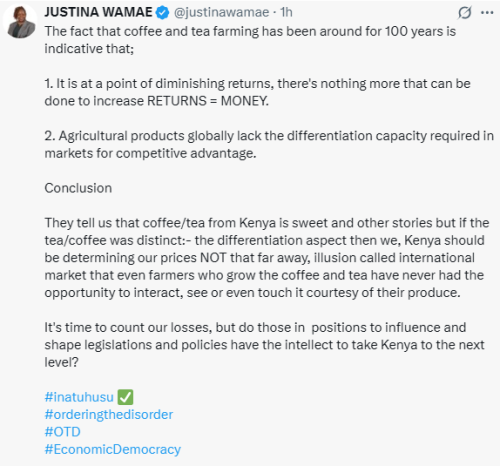
“The fact that coffee and tea farming has been around for 100 years is indicative that it is at a point of diminishing returns; there’s nothing more that can be done to increase returns = money,” she said

You Might Also Like


According to Wamae, the issue is compounded by a lack of global differentiation. “Agricultural products globally lack the differentiation capacity required in markets for competitive advantage,” she noted.
This, she argued, leaves Kenyan farmers unable to leverage the uniqueness of their produce for better prices.
Wamae also criticised the current reliance on international markets, which she described as an illusion.
“They tell us that coffee/tea from Kenya is sweet and other stories but if the tea/coffee was distinct:- the differentiation aspect then we, Kenya should be determining our prices NOT that far away, illusion called international market that even farmers who grow the coffee and tea have never had the opportunity to interact, see or even touch it courtesy of their produce,” she explained.
Elsewhere, President William Ruto said that backing agriculture was key to lowering living costs, not consumption subsidies.
The statement points to a broader concern about the country’s agricultural policies and leadership. Wamae urged policymakers and legislators to rethink their approach to maximise the sector’s potential, questioning whether those in positions of influence are equipped to drive meaningful change.
“It’s time to count our losses, but do those in positions to influence and shape legislations and policies have the intellect to take Kenya to the next level?” she added.
While Kenya’s coffee and tea are globally recognised for quality, farmers often have limited control over pricing and marketing. As Kenya approaches the next phase of agricultural transformation, voices like Wamae’s are pushing for strategic interventions that prioritise farmer empowerment, market differentiation, and sustainable growth for the iconic coffee and tea sectors.
Author
Latest News








Advertisement
More on Inside Politics