Fredrick Okango: Saba Saba changed Kenya’s democratic history
By Sharon Atieno, July 7, 2026Political strategist advisor and former KANU Secretary of Political Affairs ,Fredrick Okango has described the 1990 Saba Saba movement as one of the most defining moments in Kenya’s democratic journey, saying it marked the beginning of the country’s transition from one-party rule to multiparty democracy.
Speaking during an interview with a local television station on Tuesday, July 7, 2026, as the country marked the 36th anniversary of Saba Saba, Okango said the historic protests reflected growing public frustration with the authoritarian leadership of former President Daniel arap Moi and ignited a nationwide push for political reforms.
Kenyans rejected one-party rule
Okango said the demonstrations represented a turning point in Kenya’s history as citizens demanded greater political freedoms, constitutional reforms and accountability in government.
“History is important. The Saba Saba of the ’90s was a defining moment when Kenyans grew tired of the one-party state. President Daniel arap Moi was widely disliked by many for his authoritarian style of leadership. People took to the streets to fight for a multiparty system, constitutional reforms and greater accountability,” he said.
He noted that although the protests were violently suppressed, they laid the foundation for the democratic gains the country enjoys today.
Movement led by reform champions
Okango’s remarks echo the historical significance attached to Saba Saba, whose origins date back to July 7, 1990, when veteran opposition leaders Kenneth Matiba, Charles Rubia and Jaramogi Oginga Odinga spearheaded calls for the restoration of multiparty democracy.
Despite the government’s decision to ban the rally and arrest some of its organisers, thousands of Kenyans defied the restrictions and took to the streets, triggering demonstrations that became a watershed moment in the country’s political history.
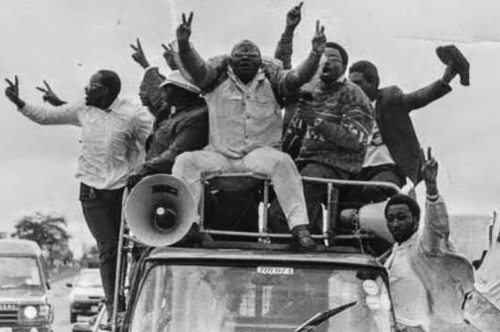
The movement later inspired sustained pressure that forced the repeal of Section 2A of the Constitution in December 1991, ending Kenya’s one-party system and paving the way for the country’s first multiparty General Election in 1992.
Legacy still shaping modern Kenya
Okango said Saba Saba remains relevant because its ideals continue to influence modern debates on governance, constitutionalism and accountability.
His remarks come as political analysts observe that while Kenya succeeded in restoring multiparty democracy and adopting the 2010 Constitution, many of the goals envisioned by the pioneers of the movement remain unfinished.
Issues such as corruption, electoral disputes, police accountability, economic inequality and protection of civil liberties continue to dominate national discourse, with many drawing parallels between the demands of the 1990 reform movement and the concerns raised by today’s youth-led civic activism.
As Kenya commemorates another Saba Saba anniversary, the movement’s legacy continues to serve as a reminder that the struggle for democracy extends beyond political freedoms to include accountable leadership, equal justice and improved livelihoods for all citizens.