DRC Senate passes bill that could open path for Tshisekedi’s third term
By Kenneth Mwenda, June 16, 2026The Senate in the Democratic Republic of Congo has approved a bill that could pave the way for a constitutional referendum and potentially allow President Félix Tshisekedi to seek a third term in office.
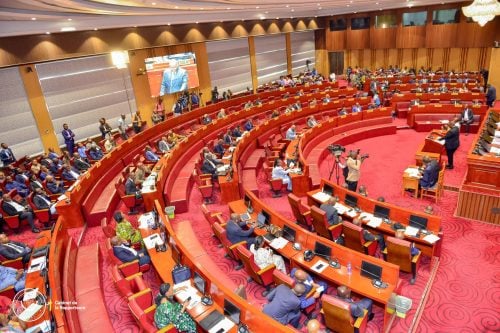
Lawmakers passed the bill on Monday, June 15, 2026, with 89 senators voting in favour and none voting against. Twenty senators did not take part in the vote. The National Assembly had already approved the legislation on June 9, 2026. The bill now awaits presidential assent.
The proposal has triggered sharp political divisions in Kinshasa and renewed fears over constitutional limits, as opposition leaders accuse the government of attempting to weaken term restrictions under the 2006 Constitution.
The new law updates how referendums are organised in the country. Supporters say it strengthens popular sovereignty and modernises outdated legal structures.
A government-aligned lawmaker defended the reform, arguing that it keeps final authority with the electorate.
However, critics say the bill goes further than procedural reform. They argue it opens a legal pathway to revisit presidential term limits, which are currently protected under Article 220 of the Constitution.
Under the 2006 Constitution, presidents may serve only two five-year terms, and Article 220 states that this rule cannot be changed through amendment.
Legal analysts say the bill introduces broader grounds for referendums, including “matters of national importance”, which they describe as vague and open to political interpretation.
Tshisekedi’s position
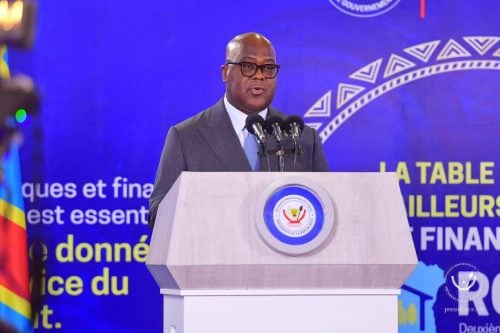
President Félix Tshisekedi, who is serving his second term due to end in 2028, has not formally declared any intention to extend his rule. However, he has previously linked any possible third term to public approval.
In earlier remarks to journalists, he said:
“I have not sought a third term, but I tell you: if the people want me to have a third term, I will accept.”
His allies argue that the Constitution no longer reflects the country’s political and security realities and needs revision to allow greater flexibility in decision-making.,
Opposition calls process unconstitutional
Opposition leaders have strongly rejected the bill, calling it a threat to constitutional order.
Senator Salomon Kalonda warned that the process risks deep political fragmentation.
“This initiative could permanently balkanise the country and deepen existing divisions,” Kalonda said after the Senate vote.
Opposition parties also boycotted parts of the parliamentary process in protest.
Former presidential candidate Martin Fayulu said the reform undermines the spirit of the Constitution.
“The #C64 Coalition informs the public that it has decided to postpone the filing of its complaint. No one can claim to change the Constitution solely for the purpose of satisfying personal ambitions or to remain in power indefinitely,” Fayulu said.
Moïse Katumbi, another key opposition figure, also criticised the timing of the reform, pointing to ongoing insecurity in the east. In recent statements, the former Katanga governor and 2023 presidential runner-up said leaders must focus on the people’s real problems – including persistent violence in eastern Congo – rather than changing the Constitution.
Legal challenge from civil society
Human rights lawyer and activist Jean-Claude Katende, head of the African Association for the Defence of Human Rights (ASADHO), said the bill violates the Constitution on several grounds.
He argued that constitutional revision is legally impossible under current conditions in parts of the country.
“The Constitution is clear: no revision is allowed during a state of siege or war. Yet eastern Congo remains under a state of siege,” Katende said.
He also accused the government of selective interpretation of constitutional principles.
“Authorities dismiss the Constitution as a ‘constitution of belligerents’, but then rely on Article 5 when it suits them. That contradiction weakens the legal foundation of the entire process,” he said.
Katende added that the referendum framework is being stretched beyond legal limits.
He described the reform as a form of “constitutional manipulation carried out through legal language”.
Violence during protests in Kinshasa
The political debate has already spilt into the streets. Protests against the bill turned violent in Kinshasa last week.
Security forces used tear gas to disperse demonstrators, while residents reported that live ammunition was also fired during clashes. Protesters threw stones at police.
Opposition activist Delly Sesanga said on social media that he was injured during the unrest.
“Delly Sesanga was hit in the leg by a bullet fired by the police of Félix Tshisekedi,” he said in a post on X.
The government has not issued a detailed public response to the allegations.
The unrest followed a sit-in organised by the Article 64 Coalition (C64), which brings together opposition parties and civil society groups. The coalition accused authorities of using excessive force.
The reform debate comes at a time of broader instability in the country. Fighting continues in eastern provinces, where armed groups remain active. Humanitarian agencies have also raised concerns about displacement and insecurity.
An Ebola outbreak and economic pressures have added further strain on government resources.
The political dispute over constitutional change risks deepening existing divisions.
The bill now moves to President Tshisekedi for final approval. If signed into law, it will allow a referendum process that could reshape the country’s constitutional framework.
Opposition groups have already signalled further mobilisation. The C64 coalition said it will announce a new phase of protest actions.