Why Nairobi’s satellite town land prices are slowing down
By Kenneth Mwenda, October 28, 2025Land prices in Nairobi’s satellite towns continued to cool in the third quarter of 2025, reflecting a slowdown in self-building and pressure from tighter household finances, according to the latest HassConsult Land Price Index.
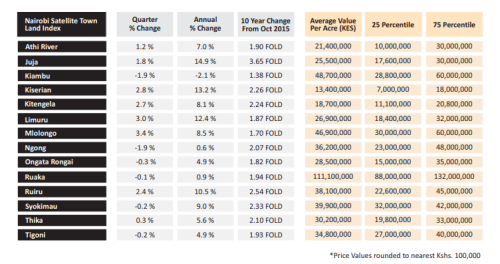
The report shows that land prices in 14 satellite towns around the capital rose by just 0.84 per cent between July and September, bringing the annual growth to 6.6 per cent. The average price per acre in these areas stood at Ksh32.3 million, far below the Ksh223.9 million recorded across Nairobi’s 18 suburbs.
HassConsult attributed the softening trend to reduced self-building activity among middle-income Kenyans who have long driven demand in areas such as Kiserian, Kitengela, and Athi River. Many had preferred these locations for their affordability, purchasing land and constructing homes gradually as incomes allowed.
“Many of these satellite areas have been prime locations for middle-class buyers to develop their own family homes in stages,” said Sakina Hassanali, co-CEO and creative director at HassConsult.
“But tightening finances are reducing the flow of buyers able to get through the initial entry gate for self-building of a land purchase, despite the far lower and more advantageous prices in the satellite areas.”
While land remains cheaper outside Nairobi, the slowdown shows how economic pressures have weighed on individual developers. Areas with strong demand from larger property developers, on the other hand, continue to see price gains.
Among satellite towns, Mlolongo recorded the strongest quarterly growth at 3.45 per cent, followed by Limuru and Kiserian. Over the year, Juja led with a 14.85 per cent rise, supported by ongoing housing and mixed-use developments. In contrast, Kiambu and Ngong posted declines of 1.94 per cent.
Developers drive gains in Nairobi suburbs
Despite the slowdown in the outskirts, land prices within Nairobi’s suburbs fared slightly better, growing by 1.22 per cent in the third quarter and 6.27 per cent over the past year. The growth was driven by renewed interest from developers focusing on mixed-use and high-density projects in prime locations.
The report highlighted Spring Valley as the best-performing suburb, with land prices rising 3.6 per cent in the quarter and 13.3 per cent over the year. The neighbourhood is undergoing rapid transformation as developers convert large stand-alone plots into apartments and commercial properties.
Other suburbs such as Karen, Lang’ata, and Gigiri also posted notable gains, driven by steady demand for both residential and commercial use. Land in Karen rose by 2.1 per cent in the quarter, while Gigiri recorded a 2.1 per cent increase as well.
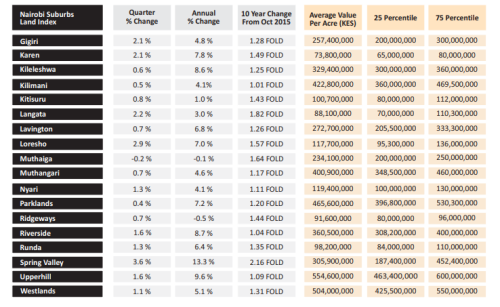
However, not all city neighbourhoods performed strongly. Muthaiga saw land prices dip by 0.2 per cent in the quarter, while Ridgeways posted a 0.5 per cent annual drop. Analysts linked the slower growth in such areas can be linked to planning restrictions and limited access to public transport, which have reduced their appeal for multi-occupation developments.
“Only areas with strong developer demand are now reporting strong land price growth,” Ms Hassanali noted, pointing out that mixed-use projects were helping sustain prices in Nairobi’s core areas.
Over a longer period, land in the Nairobi suburbs has grown 7.4 times in value since 2007, rising from about Ksh30.3 million per acre to Ksh223.9 million by September 2025. Meanwhile, land in the satellite towns has appreciated 13.23 times, from Ksh2.4 million to Ksh32.3 million per acre over the same period.
The report further compared returns from land investments with other asset classes. A Ksh1 million investment in land in the satellite towns at the end of 2007 would now be worth Ksh13.23 million. The same amount invested in Nairobi’s suburbs would have grown to Ksh7.4 million, in bonds to Ksh4.75 million, in property to Ksh2.98 million, and in equities to only Ksh0.55 million.
The data underlines land’s long-term strength as an investment, despite short-term slowdowns linked to economic strain and reduced liquidity among self-builders.
HassConsult observed that while the satellite towns still offer affordable entry points – such as Kiserian at Ksh13.4 million per acre and Kitengela at Ksh18.8 million – the sharp fall in individual buying has shifted market activity towards institutional and commercial developers.
The firm expects this divergence to continue, with Nairobi’s suburbs maintaining stronger price resilience due to redevelopment and mixed-use trends, while satellite towns remain subdued until household incomes improve.