Why bankers want 5% PAYE cut for all salaried workers
By Faith Lagat, May 19, 2026The Kenya Bankers Association (KBA) has proposed a uniform 5 per cent reduction in Pay As You Earn (PAYE) tax across all income bands, arguing that the move would increase household spending, strengthen businesses, and stimulate economic growth.
The proposal comes amid discussions around the Finance Bill 2026 and growing concern over the rising cost of living, shrinking disposable income, and increased statutory deductions affecting salaried workers.
According to KBA, reducing PAYE by 5 per cent would inject about Ksh28.1 billion annually into households through higher take-home pay. The association estimates this would immediately generate nearly Ksh42 billion in economic activity as consumers spend more on goods and services.
“We urge the Government to consider a 5% PAYE reduction for all workers to strengthen the economy and create jobs by supporting growth in productive sectors such as agriculture and manufacturing,” read the X post dated May 19, 2026, in part.
KBA says the proposal is designed to support both households and productive sectors of the economy, particularly agriculture, manufacturing and small businesses.
How the PAYE cut would affect households
KBA argues that salaried Kenyans are currently under pressure from multiple deductions, including PAYE, the Affordable Housing Levy, SHIF contributions and increased NSSF payments.
The association noted that workers have experienced a decline in real incomes over the last five years, reducing purchasing power and limiting household spending.
Under the proposal, employees across all salary bands would retain more income every month, allowing households to spend more, save more, and increase investments.
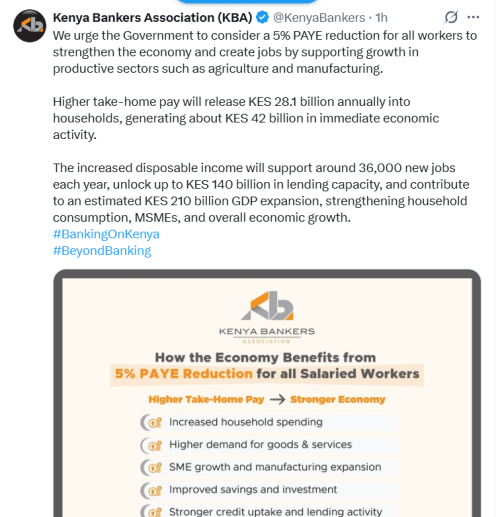
According to KBA, the additional spending would stimulate demand for goods and services, helping small and medium enterprises expand operations and increase production.
The bankers’ lobby further estimates that improved household liquidity would support stronger borrowing and credit uptake within the banking sector.
Projected impact on jobs and economic growth
KBA projects that the proposed tax reduction could support approximately 36,000 new jobs annually through increased business activity and MSME growth.
The association also estimates that the move could unlock up to Ksh140 billion in additional lending capacity and contribute about Ksh210 billion to the country’s Gross Domestic Product (GDP).
The proposal is based on the principle that higher consumption drives production, business expansion and eventually higher tax revenues through broader economic activity.
“Individuals should not be taxed higher than corporations,” KBA stated, noting that many salaried workers face effective tax burdens comparable to or higher than some corporate entities.
The association argues that the proposal aligns personal taxation with broader economic growth objectives while easing pressure on workers.
Government plans and wider tax debate
The proposal comes as Treasury Cabinet Secretary John Mbadi has indicated that the government is considering tax relief measures targeting lower-income earners.
Among the options under discussion are making salaries of Ksh30,000 and below tax-free and reducing tax rates for employees earning up to Ksh50,000.
Unlike the Treasury’s targeted approach, KBA is proposing a uniform reduction across all income bands to create a wider economic impact.
The association maintains that although the government could initially lose revenue through lower PAYE collections, increased economic activity would help recover part of the loss through higher spending, production and business growth.
As public participation on the Finance Bill 2026 continues, the PAYE proposal has become part of the broader national debate on taxation, household income and strategies to stimulate economic recovery.