Treasury clarifies Finance Bill 2026 tax proposals amid public debate
By Kenneth Mwenda, May 25, 2026The National Treasury has moved to correct what it calls widespread misinterpretation of tax proposals in the Finance Bill, 2026, saying parts of the public debate and media reporting have mixed up current proposals with withdrawn or past measures.
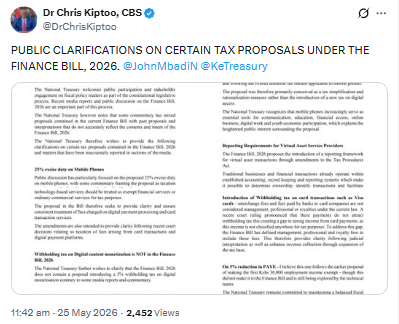
In a statement posted on X by Principal Secretary Chris Kiptoo on Monday, May 25, 2026, the Treasury said it welcomes public participation but warned that some commentary has not reflected the actual contents of the Bill.
“The National Treasury welcomes public participation and stakeholder engagement on fiscal policy matters as part of the constitutional legislative process,” the statement reads. “Recent media reports and public discussion on the Finance Bill, 2026 are an important part of this process.”
It added that some interpretations have “mixed proposals contained in the current Finance Bill with past proposals and interpretations that do not accurately reflect the contents and intent of the Finance Bill, 2026.”
The clarification comes at a time of intense debate over new and proposed taxes, especially those touching on digital services, mobile phones and financial transactions.
Mobile phone tax debate
One of the most controversial issues has been the proposed 25 per cent excise duty on mobile phones, which has been widely interpreted as a new tax on consumers.
The Treasury rejected that interpretation. It said mobile phones are already taxed under several layers of import and domestic duties, and the new proposal seeks to simplify the system rather than introduce an additional burden.
It listed the current charges as 16 per cent VAT, 10 per cent excise duty, 25 per cent import duty, 2.5 per cent Import Declaration Fee and 2 per cent Railway Development Levy.
“The National Treasury however wishes to clarify that the proposal does not introduce a new tax on mobile phones,” the statement says. “These taxes and levies cumulatively create an aggregate tax burden of approximately 55.5 per cent within the current mobile phone taxation framework.”
Under the proposed changes, the multiple charges would be replaced by a single 25 per cent excise duty applied at the point of activation. VAT, Import Declaration Fee and Railway Development Levy would be removed for mobile phones under the new system.
The Treasury said the aim is to simplify administration and improve tax efficiency.
“The proposal was therefore primarily conceived as a tax simplification and rationalisation measure rather than the introduction of a new tax on digital access,” it said.
It also acknowledged the role of mobile phones in daily life, saying they are now central to communication, education, financial services and digital work.

Virtual assets and reporting rules
The Bill also introduces a reporting framework for virtual asset service providers. The Treasury said this is meant to address gaps in the existing tax system as digital transactions grow rapidly.
It noted that traditional financial systems already have clear accounting and reporting requirements, but virtual assets have developed without a similar framework.
“The rapid growth of digital and virtual asset transactions has however created a gap within the existing legal framework due to the absence of clear reporting obligations governing such transactions,” the statement says.
The proposal, it added, applies standard reporting principles used in traditional finance to the digital sector, with the aim of improving compliance and strengthening tax administration.
The Treasury said the measure is not meant to restrict innovation but to align digital finance with existing regulatory structures.
Card payments and digital fees
The Finance Bill also clarifies the tax treatment of fees charged on digital payment systems and card transactions.
The Treasury said uncertainty has emerged over whether such services should be treated as exempt financial services or taxable commercial services, especially as payment systems evolve.
It said the Bill seeks to remove ambiguity following recent court rulings that highlighted gaps in how such income is classified.
“The amendments are also intended to provide clarity following recent court decisions relating to taxation of fees arising from card transactions and digital payment platforms,” the statement says.
The Treasury said the changes will ensure consistent treatment of digital payment services and help avoid future legal disputes.
Digital monetisation tax denied
The Treasury also dismissed reports suggesting that the Finance Bill introduces a 5 per cent withholding tax on digital content monetisation.
It said the claim is incorrect and not contained in the current Bill.
“The National Treasury further wishes to clarify that the Finance Bill, 2026 does not contain a proposal introducing a 5% withholding tax on digital monetisation contrary to some media reports and commentary,” it said.

Card transactions clarification
The Treasury has also moved to clarify how it will treat fees linked to card payments such as Visa and Mastercard transactions. It said current law does not clearly classify interchange fees and payments made by banks to card companies, creating uncertainty in taxation.
According to the statement, a recent court ruling found that these payments do not attract withholding tax under the existing framework, leaving a gap in how such income is treated.
“To address this gap, the Finance Bill has defined management, professional and royalty fees to include these fees,” the Treasury said. “This therefore provides clarity following judicial interpretation as well as enhance revenue collection through expansion of the tax base.”
The Treasury said the change is not a new tax, but a legal clarification aimed at ensuring consistency in how digital and card-based financial services are taxed.
Separation from withdrawn 2024 proposals
A major part of the clarification focused on separating the 2026 Bill from earlier withdrawn proposals, particularly those contained in the Finance Bill, 2024.
The Treasury said some ongoing public debate has wrongly revived issues that are not part of the current legislative package.
These include proposals on VAT on bread, motor vehicle circulation tax, access to mobile money transaction data, and the 2024 eco levy on phones.
“The National Treasury further clarifies that several issues currently being discussed in sections of the media and public debate… are not contained in the Finance Bill, 2026,” it said.
Digital money transfers and intermediaries
The Treasury also addressed debate around taxation of digital money transfer platforms such as M-Pesa and PesaPal.
It said the current VAT law exempts traditional financial services but does not clearly address digital intermediaries that facilitate transactions through technology platforms.
The proposal, it said, seeks to clarify taxation of ICT-driven services that fall outside conventional banking definitions.
It stressed that the intention is not to target mobile network operators unfairly.
“It is worth noting that we had a meeting with Safaricom on Friday last week and explained that they are not amongst those we are targeting,” the statement reads.
PAYE proposals under review
On income tax, the Treasury said discussions are ongoing on possible relief measures under PAYE. It said an earlier idea of exempting the first Ksh30,000 of employment income did not make it into the current Bill but remains under technical review.
The proposal to reduce PAYE further is still being assessed by internal teams, it added.
Fiscal balance and public participation
The Treasury said it remains committed to maintaining a stable fiscal framework that balances revenue mobilisation, investment needs and economic growth.
It said policy decisions will continue to take into account public concerns and economic conditions.
“The National Treasury remains committed to maintaining a balanced fiscal framework that supports revenue mobilisation, economic growth, investment, innovation and long-term economic sustainability,” it said.
The Treasury urged continued public engagement as the Bill proceeds through Parliament, saying stakeholder input remains central to the legislative process.
The clarification highlights the growing sensitivity around tax policy as Kenya navigates tight fiscal space, rising public scrutiny and pressure to balance revenue needs with cost-of-living concerns.