Mbadi gives update on e-procurement rollout as tenders cross Ksh9B
By Emmanuel Rono, June 17, 2026National Treasury Cabinet Secretary John Mbadi has said the government’s Electronic Government Procurement (e-GP) system has expanded, onboarding 1,543 public entities since its rollout in April 2025.
Appearing at the Senate on Wednesday, June 17, 2026, Mbadi noted that by May 2026, the digital platform had published 9,772 tenders and facilitated 2,604 contracts valued at more than Ksh9 billion, marking a major shift in how public procurement is conducted in the country.
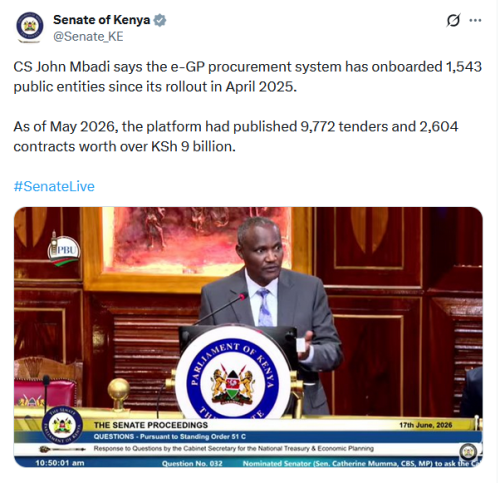
“The e-GP procurement system has onboarded 1,543 public entities since its rollout in April 2025. As of May 2026, the platform had published 9,772 tenders and 2,604 contracts worth over Ksh9 billion,” Mbadi stated.
He said the system is part of broader reforms aimed at improving transparency, efficiency, and accountability in government spending, while also reducing paperwork and delays associated with manual procurement processes.
Government procurement going fully digital
Mbadi has also announced that, starting July 1, 2026, all public procurement in Kenya will be conducted exclusively through the Electronic Government Procurement (e-GP) system, effectively banning any procurement conducted outside the platform.

Speaking on the floor of Parliament, while reading the 2026/2027 Budget on June 11, 2026, Mbadi said the directive is part of sweeping public procurement reforms aimed at eliminating manual processes, sealing loopholes, and enhancing transparency and accountability in government spending.
“Mr Speaker, to operationalise the procurement reforms and eliminate manual inefficiencies, the government officially launched the rollout of the end-to-end eGovernment procurement system in July 2025,” Mbadi said.
“Beginning July 2026, there will be no exception to procure outside the system.”
In a statement after the launch on Monday, April 7, 2025, Mbadi termed the reform a key pillar in enhancing efficiency, accountability, and value for money in the use of public funds, as it is not only a technological shift but a policy action grounded in our Constitution and supported by global best practices.