Ksh holds steady amid global economic turbulence
By Faith Lagat, August 30, 2025The Kenya Shilling has maintained remarkable stability against major international and regional currencies, the Central Bank of Kenya (CBK) reported in its Weekly Bulletin for the week ending August 28, 2025.
The local unit exchanged at Ksh129.24 per U.S. dollar, unchanged from a week earlier, despite persistent global economic uncertainties.
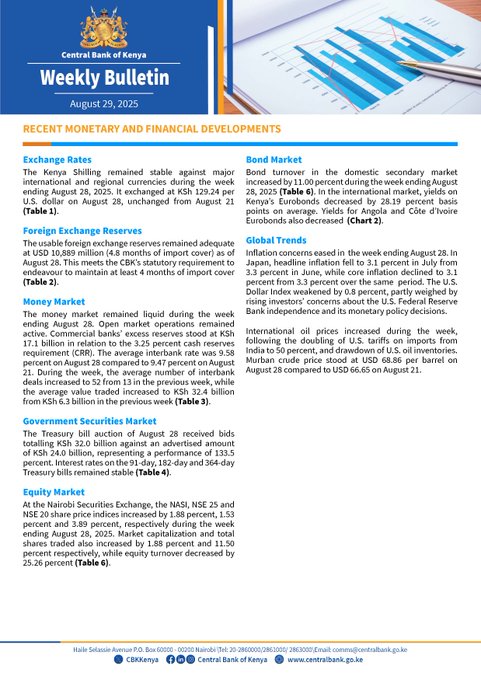
“The Kenya Shilling remained stable against major international and regional currencies during the week ending August 28, 2025. It exchanged at Ksh129.24 per U.S. dollar on August 28, unchanged from August 21, “read part of the CBK post.
The CBK noted that the shilling also held firm against the Sterling Pound, Euro, Japanese Yen, and regional currencies, including the Ugandan and Tanzanian shillings, Rwandese franc, and Burundi franc. Analysts say this steadiness reflects prudent monetary management and active interventions by the central bank to cushion the currency from volatility seen in previous years.
Strong buffer
The resilience of the shilling is largely underpinned by robust foreign exchange reserves, which stood at USD 11.037 billion as of August 21, equivalent to 4.8 months of import cover, comfortably above the statutory minimum of four months. The CBK highlighted that these reserves provide a crucial buffer against external shocks, including currency fluctuations and global commodity price swings.
“This level of usable foreign exchange reserves signals healthy management of the economy and strengthens confidence in the shilling,” the CBK said. The stable import cover comes as a relief amid global market volatility, with inflationary pressures in major economies and a stronger U.S. Dollar Index affecting emerging market currencies.
Liquidity and market outlook
In the domestic money market, liquidity remained balanced, with commercial banks’ excess reserves averaging Ksh30.4 billion against the 3.25 per cent cash reserve requirement.
The interbank rate eased slightly to 9.47 per cent from 9.48 per cent, although both the number of deals and value traded fell, reflecting cautious activity by banks. Analysts credit the stability to CBK interventions, including targeted open market operations that ensure liquidity without overheating the system.
The central bank warned, however, that external risks persist, particularly from global monetary tightening and commodity price shifts that could affect exchange rate movements.
For now, the shilling’s resilience offers optimism for businesses and consumers, shielding import costs from sudden spikes and reinforcing investor confidence in Kenya’s macroeconomic fundamentals.