KRA urges Kenyans to verify eTIMS receipts before making purchases
By Mabonga Makhanu, July 15, 2026The Kenya Revenue Authority (KRA) has urged Kenyans to always ask for a valid Electronic Tax Invoice Management System (eTIMS) receipt whenever they make a purchase, as part of efforts to promote tax compliance and curb tax evasion.
In a public awareness message shared on its official social media platforms on Wednesday, July 15, 2026, KRA advised consumers to verify key details on every eTIMS receipt before leaving a business premises.
According to the tax authority, a valid eTIMS receipt should contain three mandatory details: the supplier’s Personal Identification Number (PIN), a QR code and the total amount paid for the goods or services.
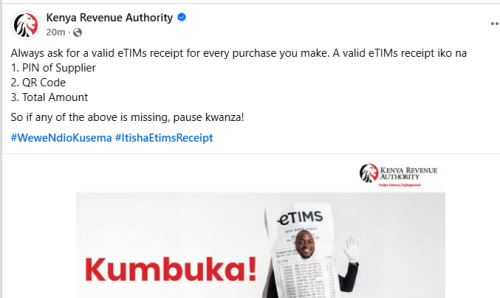
KRA warned that if any of the three details are missing, customers should pause and seek clarification from the supplier before completing the transaction.
“Always ask for a valid eTIMS receipt for every purchase you make. A valid eTIMS receipt should have the supplier PIN, QR code and total amount. If any of the above is missing, pause kwanza!” KRA said.
KRA’s update on ETIMS
The update follows scheduled system maintenance and is aimed at improving tax filing efficiency for businesses operating within both formal and informal supply chains.
KRA’s eTIMS (Electronic Tax Invoice Management System) requires electronic invoicing to improve transparency, reduce tax evasion, and create a verifiable digital audit trail.
However, many everyday business transactions occur outside the formal system, including purchases from farmers, matatu fares, supplies from Jua Kali artisans, and goods from roadside vendors.
These transactions often lack eTIMS invoices because many small-scale traders are unregistered or unable to issue electronic receipts. Previously, this made it difficult for businesses to claim valid deductions during tax filing.
“Two significant enhancements were deployed on iTax this past Sunday, and understanding them could save you time, frustration, and potentially money during this filing period,” KRA’s X post dated May 19, 2026, read in part.
Key improvements in iTax
The updated iTax system builds on the Manual Non-eTIMS CSV upload feature, allowing taxpayers to declare such expenses by uploading structured CSV files.
The system processes claims immediately after upload without requiring prior approval, reducing delays during filing. It also includes automated error detection that flags incorrect entries and guides users on necessary corrections.