KNBS: Banks remain leading channel for remittances into Kenya
By Sharon Atieno, June 16, 2026According to new findings released by the Kenya National Bureau of Statistics (KNBS), banks remain the leading channel through which money is sent into Kenya, accounting for the largest share of remittance inflows, as mobile money platforms continue to record growing usage among households receiving funds from abroad.
Speaking on Tuesday, June 16, 2026, during the presentation of the 2025 Remittance Household Survey Report, KNBS Director of Economic Statistics Benjamin Muchiri said banks account for the largest share of remittances flowing into the country.
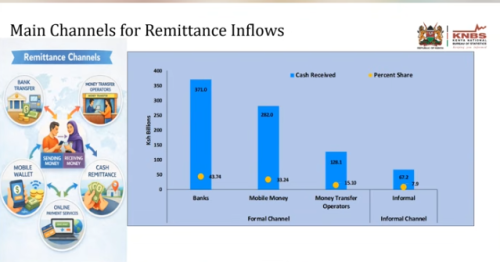
“Banks are leading with 43.7 per cent of remittances coming through banks, while mobile money accounts for 33 per cent and 7.9 per cent comes through informal channels,” Muchiri said.
The report shows that remittances continue to play a major role in supporting households, with Kenyans abroad increasingly relying on formal financial systems to send money and goods back home.
Banks remain top channel for remittances
According to the survey, bank transfers account for the largest share of remittance inflows into Kenya at 43.7 per cent, followed by mobile money platforms at 33 per cent.
Money transfer operators also account for a notable share, while informal channels contribute 7.9 per cent of remittance flows captured in the survey.
“On the left there are different channels used including banks, mobile money, money transfer operators and informal channels that households continue to rely on,” Muchiri explained.
Cost remains biggest challenge for recipients
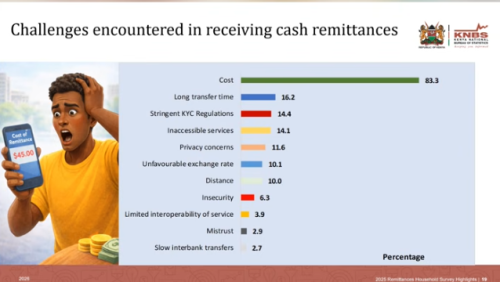
The survey further found that cost remains the biggest challenge affecting people receiving cash remittances, with 83.3 per cent of respondents citing high transfer charges.
Other major challenges identified include long transfer time at 15.2 per cent, stringent Know Your Customer (KYC) regulations at 14.4 per cent, and inaccessible services at 14.1 per cent.
Privacy and exchange rate concerns persist
KNBS also identified privacy concerns at 11.6 per cent and unfavourable exchange rates at 10.1 per cent among the challenges affecting remittance recipients.
Other issues raised include insecurity, distance, limited interoperability between services, mistrust and slow interbank transfers.
The findings are expected to guide policy reforms aimed at reducing remittance costs and improving access to safer, faster and more affordable money transfer services across Kenya.