Kenya’s financial regulators push for strict IFRS, IPSAS compliance
By Kenneth Mwenda, December 5, 2025Kenya’s top financial regulators have renewed pressure on public and private organisations to follow international reporting standards, saying better compliance will help strengthen the country’s capital markets and improve public accountability.
The call came during the FiRe Award conference in Nairobi, where the award’s promoters – ICPAK, the Capital Markets Authority, the Public Sector Accounting Standards Board, the Nairobi Securities Exchange and the Retirement Benefits Authority – stressed that organisations must follow International Financial Reporting Standards (IFRS) and International Public Sector Accounting Standards (IPSAS).
“A coalition of Kenya’s leading financial regulators is intensifying the push for public and private sector entities to adhere strictly to International Financial Reporting Standards (IFRS) and International Public Sector Accounting Standards (IPSAS),” the press release reads.
ICPAK chief executive Grace Kamau said that strict reporting standards are essential for good governance and public trust. She noted that transparent reporting protects stakeholders and supports economic growth by giving investors reliable information.
“Adherence to International Standards is the cornerstone of sound governance, accountability and public trust. When institutions embrace high-quality and transparent reporting, they do more than protect their stakeholder. Transparent reporting drives national growth, deepens investor confidence, and elevates Kenya’s standing as a market built on credibility, resilience, and ethical leadership,” Grace Kamau said.
Her remarks reflect growing pressure from institutional investors, who want financial disclosures that match global norms. Investors have often raised concerns about inconsistent reporting across Kenyan companies, saying the gaps make it harder to assess risk and commit funds to the Nairobi Securities Exchange.
NSE CEO Frank Mwiti said this year’s FiRe Award theme mirrors the worldwide move towards harmonised reporting rules. He added that companies which follow these standards strengthen their credibility and support the pillars of a strong capital market.
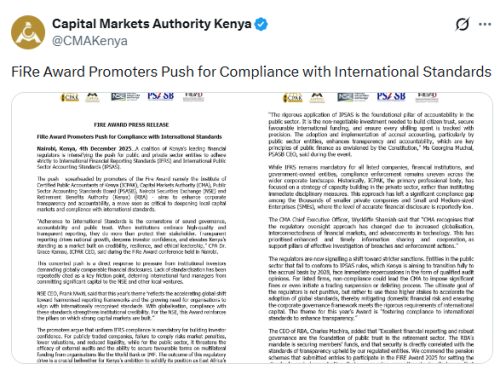
Capital Markets Authority Kenya. PHOTO/Screengrab by People Daily Digital
Boosting standards, ensuring accountability
The regulators argue that full IFRS compliance is necessary for investor confidence. Companies that fall short risk lower market valuations, reduced liquidity and penalties. For public entities, weak compliance affects the quality of external audits and could limit access to favourable terms from lenders such as the World Bank and IMF.
They view the new push as part of Kenya’s wider goal of building a modern financial system and positioning the country as a regional financial hub.
PSASB CEO Georgina Muchai said that IPSAS remains central to transparency in the public sector. She said that adopting accrual accounting will improve how public money is tracked and help institutions meet the standards expected under the Constitution. Kenya plans to complete the shift to full accrual accounting by 2028.
Although listed companies, financial institutions and state-owned enterprises must follow IFRS, enforcement across the wider private sector remains uneven. ICPAK has mainly focused on training instead of strict enforcement, a strategy that has left many smaller firms and SMEs with weak financial reporting practices.
CMA CEO Wyckliffe Shamiah noted that oversight methods have changed due to globalisation and the growth of digital financial systems. He said that regulators now prioritise faster information sharing and collaboration to improve investigations and enforcement.
The regulators now plan to take firmer action. Public entities that ignore IPSAS rules risk immediate audit consequences, while listed companies could face fines, trading suspension or delisting for serious breaches. They say the aim is not to punish institutions but to speed up the move towards international reporting standards and reduce financial risk.
RBA CEO Charles Machira praised pension schemes that entered the FiRe Award, saying strong reporting and good governance are vital to protecting members’ savings.