Kenya’s Equity and bond markets show strong performance in early January
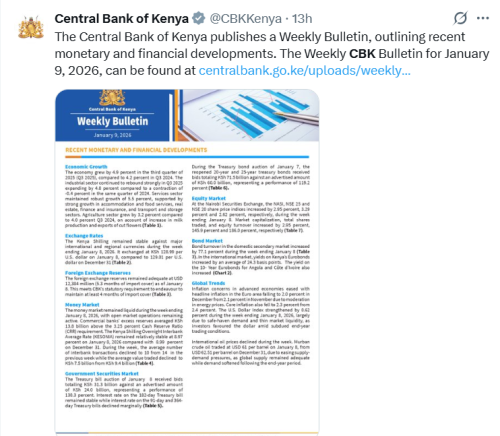
By Faith Lagat, January 10, 2026Kenya’s capital markets started 2026 on a robust note, with the Nairobi Securities Exchange (NSE) recording gains across major indices and heightened trading activity during the week ending January 8, according to the Central Bank of Kenya (CBK) Weekly Bulletin dated January 9, 2026.
The NSE All-Share Index (NASI) rose by 2.95 per cent, while the NSE 25 and NSE 20 share price indices increased by 3.29 per cent and 2.62 per cent, respectively.
Equity market records broad gains
Market capitalisation also grew by 2.95 per cent, reflecting rising overall investor wealth. Total shares traded surged by 145.9 per cent, while equity turnover jumped 186.0 per cent, signalling renewed investor confidence and increased participation in the first full trading week of the year.
The sharp rise in trading volumes demonstrates strong liquidity in the equity market as investors positioned themselves following a strong close to 2025.
“At the Nairobi Securities Exchange, the NASI, NSE 25 and NSE 20 share price indices increased by 2.95 per cent, 3.29 per cent and 2.62 per cent, respectively, during the week ending January 8. Market capitalisation, total shares traded, and equity turnover increased by 2.95 per cent, 145.9 per cent and 186.0 per cent, respectively.”
Bond market shows resilience
The domestic bond market also recorded significant activity, with turnover in the secondary market rising by 77.1 per cent during the same period. On the international front, yields on Kenya’s Eurobonds increased by an average of 24.3 basis points, reflecting adjustments in global risk perceptions.
For comparison, the 10-year Eurobond yields for regional peers Angola and Côte d’Ivoire also rose, according to the CBK bulletin. These trends indicate sustained demand for fixed-income securities even as equities attracted strong investor interest.
Global trends and market outlook
Globally, headline inflation in the Euro area declined to 2.0 percent in December from 2.1 percent in November, while core inflation eased to 2.3 percent from 2.4 percent, driven by moderation in energy prices. The U.S. Dollar Index strengthened by 0.62 per cent amid safe-haven demand and thin end-of-year market liquidity.
International oil prices fell, with Murban crude trading at USD 61 per barrel on January 8, down from USD 62.51 on December 31, as global supply remained adequate and demand softened.
Kenya’s strong start to 2026 is supported by solid macroeconomic fundamentals, with foreign exchange reserves at USD 12,384 million (5.3 months of import cover) and stable money market rates, with the Kenya Shilling Overnight Interbank Average Rate (KESONIA) around 8.97–9.00 per cent.