Kenya shilling steady as investor confidence grows
By Faith Lagat, February 28, 2026The Central Bank of Kenya (CBK) has reported continued stability in key macroeconomic indicators, highlighting steady inflation, a resilient shilling, strong foreign reserves, and high investor appetite for government securities.
The findings were published in the CBK Weekly Bulletin on February 27, 2026.
Headline inflation held relatively stable at 4.3 percent in February, down slightly from 4.4 percent in January. Core inflation, which excludes volatile items, declined to 2.1 percent from 2.2 percent, driven mainly by lower processed food prices.
Non-core inflation eased to 10.1 percent from 10.3 percent, largely due to falling energy costs. The trends indicate sustained price stability, supported by moderated food and fuel prices amid global uncertainties.
The Kenyan shilling maintained its value at Ksh129.02 per US dollar as of February 26, holding steady against major currencies, including the sterling pound and euro.
“The Kenya Shilling remained stable against major international and regional currencies during the week ending February 26, 2026. It exchanged at Ksh129.02 per U.S. dollar on February 26, unchanged from February 19.”
Foreign exchange reserves stood at Ksh1.617 trillion, equivalent to 5.4 months of import cover, comfortably above the statutory minimum of four months. This provides a buffer against external shocks and underpins currency stability.
Treasury bills oversubscribe amid strong demand
The money market remained liquid, with commercial banks holding excess reserves averaging Ksh52.3 billion above the 3.25 percent Cash Reserve Ratio requirement.
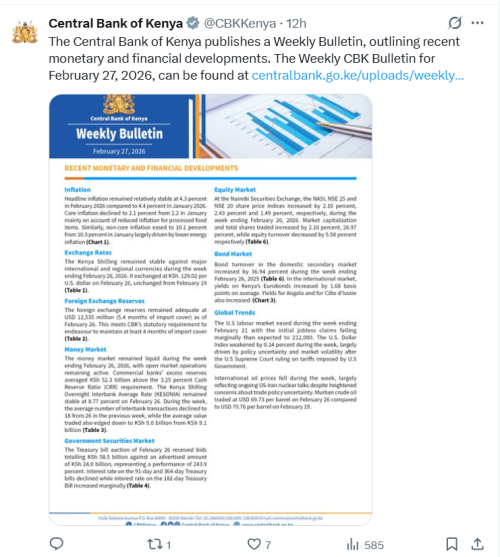
The Kenya Shilling Overnight Interbank Average Rate (KESONIA) stayed stable at 8.77 percent, though interbank transaction volumes saw slight declines during the week ending February 26.
Treasury bills dominated attention, with the February 26 auction attracting bids totalling Ksh58.5 billion against an advertised Ksh24 billion, a 243.9 percent oversubscription.
Yields on 91-day bills fell to 7.580 percent, while 364-day bills dropped to 8.789 percent, reflecting expectations of continued accommodative monetary conditions following a recent CBR reduction.
The 182-day paper saw a marginal uptick. The oversubscription demonstrates sustained investor confidence in short-term government securities.
Positive market sentiment supports broader economy
The Nairobi Securities Exchange All Share Index (NASI) rose 2.1 percent over the week, supported by gains in key equity counters.
Domestic debt composition showed Treasury bonds dominating at around 83 percent, with financial corporations holding the largest share of government securities.
Overall, these developments point to a resilient economy with controlled inflation, stable currency, sufficient reserves, and active domestic borrowing markets.
The strong T-bill performance is expected to ease government financing pressures while reinforcing the CBK’s monetary policy framework.