Inside 5 sectors that delivered KRA’s Ksh 2.844T revenue record
By Kenneth Mwenda, July 11, 2026The Kenya Revenue Authority (KRA) recorded its strongest revenue growth in recent years after collecting Ksh2.844 trillion during the 2025/26 financial year, with five sectors of the economy accounting for nearly two-thirds of the total tax collections.
The tax authority announced that revenue grew by 10.6 per cent, up from 6.8 per cent recorded in the previous financial year, despite operating in what it described as a challenging economic environment.
KRA collected Ksh2.844 trillion, an increase of Ksh272.95 billion from the Ksh2.572 trillion collected in FY2024/25. The performance reflects stronger domestic revenue mobilisation, improved tax administration and solid growth in sectors that continue to drive Kenya’s economy.
According to KRA, Manufacturing, Energy, Financial and Insurance, Information and Communication Technology (ICT), and Wholesale and Retail Trade generated approximately 62 per cent of all revenue collected during the financial year.
“Five key sectors of the economy accounted for approximately 62.0 per cent of total revenue,” KRA said in its FY 2025/2026 revenue performance report.
Although these sectors account for only 27.4 per cent of Kenya’s nominal Gross Domestic Product (GDP), they posted a combined revenue growth of 8 per cent, making them the backbone of government tax collections.
Manufacturing remained the biggest contributor
Manufacturing emerged as the single largest contributor to KRA’s revenue.
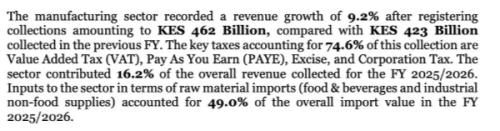
The sector generated Ksh462 billion, up from Ksh423 billion collected in the previous financial year, representing 9.2 per cent growth. It contributed 16.2 per cent of all revenue collected by KRA.
The authority said Value Added Tax (VAT), Pay As You Earn (PAYE), Excise Duty and Corporation Tax accounted for nearly 74.6 per cent of taxes paid by manufacturers.
KRA also noted the importance of imports in supporting the sector, revealing that food and beverage inputs together with industrial raw materials accounted for 49 per cent of Kenya’s total import value during the financial year.
The figures underline manufacturing’s continued importance as one of the country’s largest taxpayers and a major source of employment and industrial activity.
Energy sector delivered strong customs taxes
The Energy sector followed closely after collecting Ksh445 billion, representing 15.6 per cent of KRA’s total revenue.
Collections from the sector grew by 9.1 per cent, mainly due to improved performance in Customs oil taxes.
The strong showing helped Customs Revenue exceed its annual target.
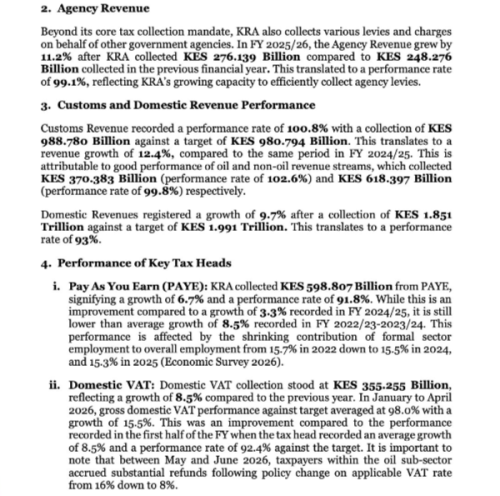
Overall, Customs Revenue reached Ksh988.78 billion, surpassing its target of Ksh980.79 billion for a performance rate of 100.8 per cent.
Oil-related customs taxes generated Ksh370.38 billion, achieving 102.6 per cent of the target, while non-oil customs revenue contributed Ksh618.4 billion.

The performance demonstrates the significant role fuel imports continue to play in financing government operations.
Financial sector remained a major taxpayer
Banks, insurance firms and other financial institutions also maintained their position among Kenya’s biggest taxpayers.
The Financial and Insurance sector generated Ksh320 billion, compared with Ksh311 billion in the previous year.
The sector accounted for 11.3 per cent of KRA’s total collections.
Corporation Tax contributed 34.8 per cent of taxes paid by financial institutions, while Withholding Income Tax and PAYE together accounted for 47.1 per cent.
The figures show that profitability and formal employment within the financial sector continue to support government revenue.

ICT sector continued its steady growth
Kenya’s expanding digital economy also boosted tax collections.
Revenue from the Information and Communication Technology (ICT) sector increased from Ksh230 billion to Ksh248 billion, representing 7.9 per cent growth.
The sector contributed 8.7 per cent of KRA’s overall revenue.
Major tax sources included Excise Duty on airtime and financial services, Corporation Tax, Domestic VAT and PAYE.
The results reflect the growing importance of telecommunications, digital payments and technology businesses in Kenya’s tax base.

Wholesale and retail trade exceeded 10 per cent growth
Wholesale and retail businesses also delivered strong results.
The sector generated Ksh288 billion, compared with Ksh261 billion collected a year earlier.
This represented 10.3 per cent growth, making it one of the fastest-growing contributors among KRA’s leading sectors.
Overall, wholesale and retail trade contributed 10.1 per cent of total revenue collected during FY2025/26.

Stronger collections across tax categories
Beyond the key sectors, KRA recorded growth across several revenue streams.
Exchequer revenue, which finances government expenditure, rose by 10.5 per cent to Ksh2.568 trillion, achieving 95.2 per cent of its target.
Meanwhile, Agency Revenue—money collected on behalf of other government agencies—grew by 11.2 per cent to Ksh276.14 billion, reaching 99.1 per cent of its target.
Domestic Revenue increased by 9.7 per cent to Ksh1.851 trillion.
Among individual tax heads, PAYE generated Ksh598.81 billion, representing 6.7 per cent growth.
However, KRA noted that PAYE growth remained below historical averages because formal employment continues to account for a smaller share of total employment.
According to the Economic Survey 2026, formal employment contributed 15.7 per cent of total employment in 2022 before falling to 15.5 per cent in 2024 and 15.3 per cent in 2025.
Domestic VAT collections reached Ksh355.26 billion, recording 8.5 per cent growth.
KRA explained that VAT collections improved significantly between January and April 2026, but refunds issued to oil companies after the VAT rate was reduced from 16 per cent to 8 per cent affected collections in May and June.
When the government lowered VAT on petroleum products, many companies that had previously paid tax at the higher rate became eligible for refunds. These repayments reduced the net VAT collected during the final months of the financial year even though underlying business activity remained strong.
Other Notable Tax Heads
- Betting Taxes: Excise Tax on betting services surpassed the target with a surplus of Ksh2.267 Billion (performance rate of 115.9%). The tax head collected Ksh16.527 billion against a target of Ksh14.261 billion, registering 24.9 per cent growth.
- Domestic Excise: Collections reached Ksh61.845 billion, with alcoholic beverages accounting for 69.3 per cent and tobacco products 14.9 per cent.
- Significant Economic Presence Tax (SEPT)/Digital Service Tax (DST): Collections doubled to Ksh1.609 billion from Ksh0.807 billion in the previous year.
Digital reforms aimed at sustaining growth
As KRA reported its strongest growth in recent years, it also rolled out reforms intended to improve tax compliance.
The authority recently introduced a six-month tax amnesty, running from July 1 to December 31, 2026, allowing eligible taxpayers to clear tax debts accrued before January 2026 without paying penalties, interest, or fines, provided they settle the principal tax.
KRA has also announced that it will replace the long-standing Excel-based tax return filing system with a fully web-based platform.
Speaking on the changes, KRA Chief Manager for Policy and Tax Advisory Josephine Mugure said the reforms are intended to simplify compliance.
“We are not going to require you to fill out the Excel sheet anymore. It will be web-based and simplified for all the annual returns, both for individuals and companies, making it less system-intensive and less tedious,” she said.
The authority has also removed the validation process introduced during the first phase of eTIMS implementation and introduced staggered filing deadlines, with individual taxpayers expected to file returns by April 30 and companies by June 30.
The Authority has rolled out pre-populated returns, WhatsApp chatbot, USSD (*222#), and the eCustoms mobile application to simplify compliance. It has also strengthened grassroots service through the Ushuru Mashinani programme (1,261 agents countrywide) and county-based Citizen Assembly forums.
Through the Tax Base Expansion (TBE) programme, KRA collected an additional Ksh9.1 Billion by onboarding previously inactive taxpayers.
These reforms, together with continued investment in digital systems such as iTax and the Shuru virtual assistant, are expected to strengthen voluntary tax compliance while reducing pressure on KRA’s online platforms during peak filing periods.
The latest revenue figures suggest that Kenya’s tax base remains concentrated around a handful of productive sectors. As manufacturing, energy, finance, ICT and wholesale trade continue expanding, they are likely to remain the country’s biggest drivers of tax revenue and a critical source of funding for government programmes in the coming financial year.