Govt banks on IMF-backed reforms in fiscal stability drive
By Faith Lagat, April 14, 2026Kenya will continue implementing IMF-backed reforms to anchor fiscal stability amid a challenging global environment, Principal Secretary for the National Treasury Dr Chris Kiptoo has said.
Speaking during the 2026 IMF-World Bank Spring Meetings in Washington, DC, Kiptoo said the government remains committed to close collaboration with the International Monetary Fund to strengthen market confidence, mobilise financing, and respond to external shocks and domestic constraints.
“Kenya continues to benefit from International Monetary Fund support, which has helped maintain macroeconomic stability and advance fiscal consolidation,” Kiptoo said in a post on X dated April 13, 2026.
He made the remarks after joining National Treasury Cabinet Secretary John Mbadi in a meeting with IMF Managing Director Kristalina Georgieva. The delegation also included Central Bank of Kenya Governor Kamau Thugge and Deputy Governor Susan Koech.
IMF and World Bank engagements in Washington DC
Kiptoo said Kenya’s discussions with multilateral lenders form part of ongoing efforts to support fiscal reforms and financing programmes.
The talks also covered engagement with the World Bank Group, where the government is seeking to fast-track projects under the Bottom-Up Economic Transformation Agenda. Kenya is also pursuing accelerated disbursements under the Development Policy Operations 7 programme valued at up to Ksh 97.5 billion.
During the meetings, Kiptoo held bilateral talks with Zarau Kibwe, Executive Director for the Africa Group 1 Constituency at the World Bank. He noted Kenya’s appreciation for the leadership that supports 22 Sub-Saharan African countries represented in the constituency.
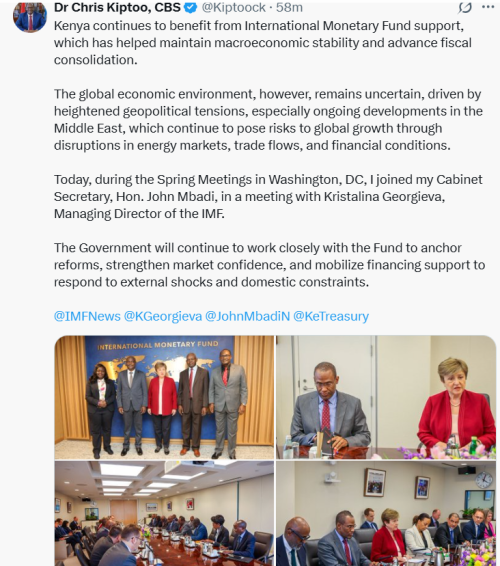
The engagements come as the government pushes for improved execution of donor-funded development projects and strengthened coordination with international financial institutions.
Global economic outlook and policy coordination
The discussions took place against a backdrop of global economic uncertainty driven by geopolitical tensions in the Middle East. The developments have affected energy markets, trade flows, and financial conditions, with implications for growth and inflation in import-dependent economies.
Joint coordination between the IMF, World Bank, and International Energy Agency was established on April 2, 2026, to assess risks and provide policy responses, particularly for low-income countries.
Kiptoo said Kenya continues to align its economic strategy with reforms aimed at fiscal consolidation and resilience building. Public debt remains at about Ksh12.25 trillion, with the debt-to-GDP ratio estimated at 67 to 68 percent, leading to continued reliance on both domestic and external borrowing.
Treasury officials maintain that ongoing reforms are intended to support stability while managing financing needs and development priorities under the Bottom-Up Economic Transformation Agenda.