EPRA explains why electricity bills spike and how to cut them
By Emmanuel Rono, March 24, 2026The Energy and Petroleum Regulatory Authority (EPRA) has detailed the complex factors driving electricity costs and the initiatives available for consumers to significantly reduce their monthly bills.
In its latest biannual report covering the first half of the 2025/2026 financial year, the electricity demand in Kenya rose by 8.25 per cent during the period July to December 2025, reflecting both growing household and industrial consumption.
“Electricity demand increased by 8.25 per cent compared to a similar period in the previous financial year, reflecting sustained economic activity and growing consumption among domestic and industrial customers,” part of the report read.

The report stated that the country recorded a peak demand of 2,439.06 MW on 3rd December 2025, underscoring the expanding energy needs of our economy.
Why Electricity Bills Spike
According to the report, the final retail price of electricity is not just a flat rate but a combination of the base tariff, pass-through charges, and applicable taxes and levies.
While base tariffs remain relatively stable across a tariff control period, spikes in monthly bills are primarily driven by pass-through costs, which fluctuate based on external economic factors.
The report shows that households consuming over 100 kilowatt-hours (kWh) per month are classified under Domestic Consumer 3 (DC3), which carries a base tariff of Ksh18.57 per kWh, resulting in higher bills.
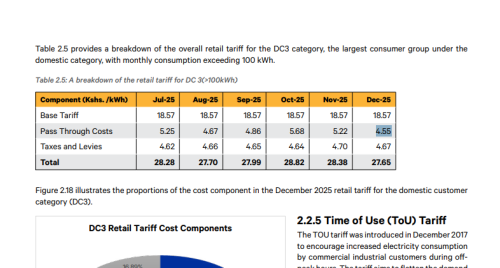
Additional pass-through costs, including the Fuel Energy Charge (FEC), Foreign Exchange Rate Adjustment (FERA), Water Resource Authority (WRA) levy, and inflation adjustments, add between Ksh 4.55 and 5.68 per kWh. Taxes and levies contribute another Ksh 4.6–4.7 per kWh, explaining the sharp increase for households exceeding the 100 kWh threshold.
The Authority noted that pass-through charges are implemented to cover additional expenses incurred in the provision of generation, transmission and distribution of electricity, which are not included in the base tariff.
These include Fuel Energy Charge (FEC), Foreign Exchange Rates Fluctuations Adjustments (FERFA), Water Resource Authority (WRA) levy, Inflation Adjustments, and taxes and levies. The FEC exhibited fluctuations during the review period, with the lowest at Ksh. 2.99/kWh in August, and the highest at Ksh. 3.81/kWh in November 2025. These fluctuations are attributed to varying quanta of thermal power dispatch
When electricity demand increases or renewable sources like hydro face limited hydrology due to low rainfall, the country relies more on expensive thermal generation, causing the FEC to rise.
From July to December 2025, 148 GWh of energy was sold under ToU. Beneficiaries saved a total of Ksh971 million, which is Ksh282 million more than the same time last year.
The report said that this means customers can save money on their bills by doing things that use a lot of energy, like doing laundry or cooking, during off-peak hours.
It also became clear that regional differences have an impact on bills. Nairobi, which includes the counties of Kiambu, Kajiado, Machakos, and Makueni, used 44.24 percent of all electricity. The Coast region saw a small drop of 1.04 percent.
South Nyanza, which includes Kisii, Nyamira, and Migori, on the other hand, had the fastest growth at 22.53%.